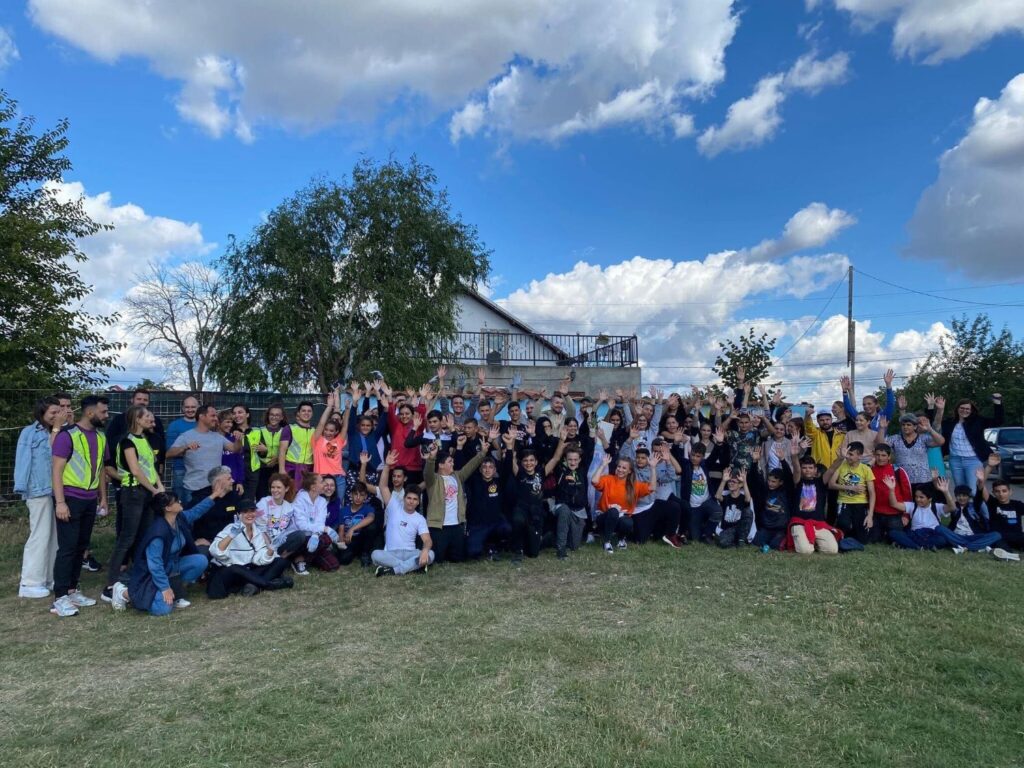
Why not sit at the same table?

Why not sit at the same table?

Funds supported by several companies and dedicated to a single field can create real and sustainable change. 

Text by Roxana Sofică and Ioana Szatmari 

In recent years, companies have understood that a healthy CSR is more than just annual funding. We see, timidly, how multiannual funds appear, through which non-governmental organizations are supported for a longer period more than the bi-regulation of results on paper, but a serious impact among the beneficiaries. 

Budgets are rising. There are now funds of 500,000-1,000,000 euros directed to organizations in a certain field. Even though most of it ends up in the area of health infrastructure (where needs and costs are high), part of this money is directed to areas such as citizens' rights and civil liberties, minorities and the environment. 

Each fund has its own specificity and mode of intervention, and even if we set up ten funding funds dedicated to environmental organisations, the impact will remain low. That's because everyone has their priorities, they want certain interventions, certain results. 

But what if I had five funds in one? How would the lives of organizations, and especially their work, improve if five companies — each with a million euros at hand — sat at the same table?  

In order to be able to initiate such common funds, we should put together some necessary criteria: 

  • Those who invest in funds should be willing to work alongside other partners, so understand that they do not invest exclusively / are not the best in the field. There is no competition on promoting the contribution of the members of the funds.
  • To devote time, energy, knowledge to strengthening the fund and development directions.
  • Let there be a common understanding of the values underlying the fund's officials.

The establishment of a common fund shows that grantmakers (specialists from companies and organizations) have reached a level of maturity and strategic thinking in which the problem and the solutions found to solve it come first. That means these grantmakers are working together to create a common design of that fund. They start from their own ideas and experience to find the most effective work model. It shows flexibility, progressive thinking and openness to find other work models than the ones each of them have.

More importantly, such a project shows a kind of modesty: a single financier is aware does not own the solution on his own and that together they can be stronger. The key element for this to happen is the trust between the partners and the openness with which they start on the road. There will certainly be sensitive moments, and in order to manage them healthily, trust is needed.

How does it work?

The advantages for companies and organizations are numerous, but we are going through a few. First, a larger background means a more complex vision, where the change it generates is easier to track and measure. When two or more funders work together, the resources are significantly higher and the impact is greater. The common funds could respond on a different scale to the identified needs and in a shorter time. More coherent, because they pursue a common vision. 

Continuity of projects is easier to ensure. CSR/community investment budgets can vary from one year to the next in the case of a company. But when budgets are managed in a common fund, the effects of variations in individual budgets are minimized, and organizations can more easily build their strategies and interventions. 

Efficiency of administration. Efficiency comes from two directions. On the one hand, organizations apply for a single fund, and the communication and administration effort is unique, they do not have to invest time and resources to access and implement more funding. On the other hand, from the perspective of managing the fund, the effort is greatly simplified than if there are more funds: there is, for example, no risk of overlap and difficulty distinguishing between different funds.

Democratic access to resources. Several community partners of different sizes and with diverse expertise can be selected. Joint funds can also be structured according to the size of the partners and their expertise.

Space can be created for the development of community partners. When the fund is large enough, resources for investments can be dedicated to increasing the capacity of partners. The initiators of the joint funds can also assume the role of coagulation and stimulation of the learning processes between the funded projects, so as to create networks that develop the approached subject. In addition, once the resources are in a common fund, the willingness to invest in in-depth research for the field approached increases.

Diversified resources. Each participant in the fund can bring several types of resources, beyond the financial ones. There may be contributions to know-how/expertise, human resource, in-kind, technical or physical infrastructure, etc.

Systemic impact versus point-to-point impact. Once the creators of the funds produce a significant impact, they have information of context and depth, become a benchmark for those working in the field and can become generators and carriers of change in relation to the authorities in that field.

A common design of a grant program means the exchange of ideas, experience and expertise of grantmakers. The idea itself that two or more grantmakers or companies should ally themselves to solve a problem that I see important, emphasizes the importance and size of the problem. This problem is so big and so relevant that there are different companies coming together and making a common fund to solve it. That's where others can come from. 

The idea of partnership can also be extended to grantees, which may have a common space to generate solutions, to act together, to cover different areas or needs, to synchronize or calibrate interventions.

Share on facebook
Facebook
Share on twitter
Twitter
Share on linkedin
LinkedIn

Editorial Board Recommendations

Subscribe to our newsletter

Together

Together

How can we react more quickly and gain a common voice, for the good of more people?

Text by George Gurescu

Two months ago, during a sectoral meeting organized by ARC, a representative of an organization wondered: but what can we not also be like HORECA? Why can't we have one voice? Why can't we react quickly and in a unified way when something happens that affects the sector?

From this question I started when I put together the third edition of the Chronicles. What would it be like to be united enough to be heard when a law is made, when a pandemic comes upon us, when the rights of a minority are violated, or when we are putting the future of this country on the line?

Success is all about the united are us, and the articles we've collected show that. The pandemic and the humanitarian crisis that is happening now at Romania's borders have already shown us that it is in our nature to work together. Two years ago we were sharing medical equipment trucks with each other to get to hospitals faster, and now we are sharing resources at crossings or raising funds for organizations that know best how to intervene in a crisis situation. You will see, in the siret reportage written by Mădălina Olariu, how the organizations put their resources together to offer a little courage and a bit of security to the Ukrainians forced to leave their country because of the war.   

Cătălin Hopulele, a journalist at Ziarul de Iași, wrote about how organizations intervene in vulnerable communities in the north-east of the country, to help children overcome more of the obstacles they encounter on the way to an independent life. Many such hindrances should not have existed if we had a coherent public education.

We look at what the power of organizations also means when it comes to relations with the state. The Economic and Social Council (ESC), an institution established in 2003, brings representatives of civil society, trade unions and employers' associations to the same table with the aim of achieving a tripartite dialogue leading to better laws and better communication with the state. But what power does the opinion of the ESC, which is binding but advisory, have, and the authorities are not the fairest player? We discussed this with three professionals from the sector, two of them members in CES.

To be together is to bring to the same table those who help us do good. We look at what is happening in the Republic of Moldova and how vital it is to provide healthy funding to help organizations not only to continue to provide services, but also to create them. Georgeta Carasiucenco, from Moldova.rg, went on the field and talked to the people of the National Coalition "LIFE WITHOUT DOMESTIC VIOLENCE" about what it means for the financier to trust you. 

We need a framework in which to come together and talk about the sector, about what we can do for society. But more than that, we need confidence.

The stutters of the state in recent weeks, but also in the last 2 years, show us this. We cannot grow if the sector is not at the same table from the very beginning. If we only act after the event has happened, we can only mitigate the effects. 


Share on facebook
Facebook
Share on twitter
Twitter
Share on linkedin
LinkedIn

Editorial Board Recommendations

Subscribe to our newsletter

Tax facility 20% – how to help the community easily, at no cost

Tax facility 20% – how to help the community easily, at no cost

Sponsorship potential is only used at 41% of capacity by companies that can do so. The 20% keep children in school, repair hospital wards, support culture, protect the environment and help us live in healthy communities.

Text by Sînziana Wolff

In 2020, only 49,550 companies out of the 606,995 currently eligible in Romania recorded sponsorship expenses and directed up to 20% of the tax to eligible entities, including NGOs. The total targeted value in 2020 was 335.9 million euros, up 12% from the previous year. 

These are a part of the data emerged from the research project conducted by the Association for Community Relations (ARC) together with EY Romania, which aims to raise awareness about the tax credit of 20%. Within this project, a series of data obtained from ANAF were analyzed, regarding the sponsorship potential through the 20% tax facility.

The Law on Sponsorship and the Fiscal Code allow companies paying profit tax to offer sponsorships to non-profit entities / public authorities / individuals for their activities carried out in certain fields (for example, culture, education, humanitarian, social) and to benefit from tax incentives, under certain conditions provided by law.

The sponsorship expense offered is not a tax-deductible expense, but it can represent a tax credit, i.e. it can reduce the income tax payable by the full amount of sponsorship offered. The Fiscal Code provides the following limits (minimum of): 20% of the profit tax due or 0.75% of the turnover. Moreover, companies that are taxable on the incomes of micro-enterprises and that make sponsorships, according to the Sponsorship Law, to support non-profit entities and places of worship, deduct the related amounts from the tax on the incomes of micro-enterprises up to the level of the amount representing 20% of the tax due for the quarter in which they recorded the respective expenses. 

Starting with January 1, 2022 (or with the date of the start of the fiscal year 2022 – 2023 in the case of legal entities that have opted for a financial year different from the calendar year), if the sponsorships made do not exceed the ceiling mentioned above, thus remaining an unused positive difference, for this positive difference, the taxpayer may have the "redirection of the corporate tax" for making sponsorships within a maximum of 6 months from the date of sponsorships within a maximum of 6 months from the date of submission of the annual corporate tax return / related tax return. If by 2021 for sponsorship-related expenses that exceeded in the reference year the limits allowed for tax credit, the eligible amounts were reported for 7 years in the case of corporate tax payers, respectively for a period of 28 consecutive quarters in the case of micro-enterprise income tax payers, this is no longer possible for the amounts registered starting with 2022. However, the amounts carried over from the past (for the years 2015-2021) will be able to be used until 2028. The recovery of these amounts for tax credit purposes shall be made in the order of their registration, under the same conditions, at each deadline for payment of the tax. – Press release EY and ARC

Why is 20% deductible sponsorship important?

Through this deductible sponsorship, the state encourages companies to support an important cause for them in the communities in which they operate and provides them with a decision lever by providing these funds.

The good relationship between an NGO and a local company matters enormously to the health of the community. A study conducted by EY and ARC, launched in 2022, shows that the main reason why companies use the facility is related to the responsibility they have towards the problems of the community in which they operate (36.6% of 150 respondents companies). 26.8% motivated the use "due to the existence of tax deduction (the support does not involve costs for the company)", and 12.2% replied that it is a moral duty.

However, the sponsorship potential is only used at 41% of capacity by companies that can do so. If all eligible firms had used this facility to their full potential, more than 811 million euros could be directed. 

What can non-governmental organisations do?

  • To turn their attention to local companies and open a relationship with them. Most of the time, the reasons why a company doesn't direct are either because it wasn't approached, or because it didn't know the tax facility.
  • To address more small and medium-sized companies than few large companies. Very often, large companies are approached by many organizations to which they direct 20%. It is also strategically healthier for an organization to gather support from as many places as possible.
  • Maintain long-standing relationships with the companies that support them. Establishing the relationship translates into a lot of initial investment, but maintaining it means long-term support and multi-year forecasting capacity.

Relationships are supported by a donor system that – organizations should have a database with at least a few identification data, where sponsors, contacts, when they were approached, how many times they sponsored, etc. are registered. The database can even be a secure Excel, but it's important to have data monitoring of those who support the organization.

What can companies do?

  • To establish trusting relationships with non-governmental organizations, in which the two actors are on an equal footing and trust: the company supports a change for the better, which is achieved by experts in organizations.
  • To focus on long-term change – to support the same multi-annual organizations so that they can plan their work without the pressure of constantly seeking financial support.
  • Have a record of their support so that there is no resumption of the relationship if a contact or decision-maker in relation to organizations will go to another position or company.
  • To communicate openly with non-governmental organizations and to have trust between the two parties. After all, we all want to live in healthy and prosperous communities, and these steps just take us closer to what we want.

EY has written a very useful guide for any company that wants to direct 20% of the corporate tax, which you can find at the following link.

Share on facebook
Facebook
Share on twitter
Twitter
Share on linkedin
LinkedIn

Editorial Board Recommendations

Subscribe to our newsletter

How healthy and flexible grants help in the fight against domestic violence. Case study: Republic of Moldova

How healthy and flexible grants help in the fight against domestic violence. Case study: Republic of Moldova

Where do you go when fear takes place at home?

Text by Georgeta Carasiucenco

Maria enters the rest room of the maternal center for victims of domestic violence. She's skinny, has her hair caught in a simple tail, she wears a pink hoodie and leather pants. He sat carefully on the armchair. She put her foot over her leg and sits slightly gasped. He is 28 years old and has three children aged 4,6 and 7. 

She had married in the spring and was due to have her wedding in the fall. Meanwhile, she was beaten, became pregnant and with a bitter taste: the money for the event was borrowed, relatives had been announced. "What will the world say if we cancel the wedding?" said the mother. On the wedding night, Maria was beaten, because she reproached her new husband for collecting all the food from the table, when they had agreed to share a half with her relatives.

Maria is still affected by what has happened to her all these 7 years. He remembers as if through the fog the last beatings he received. It gets lost in the data, in the details and in the emotions they stir up. He can't find his words, he sighs, and he can barely tie his thoughts together. "He came intoxicated after midnight, grumbling. ' Arise. What are you sleeping for?' he yelled at me. I didn't react. He unveiled me, pulled me by the feet. I was somehow trying to defend myself... or not... I pushed him or not... I don't remember. But I remember he hit me, I fell, and he grabbed me by the neck. So hard he squeezed me that he was ready for me, he was...", Maria pauses and sighs hard.

His voice trembles. "I was losing consciousness. The next night followed the same story with quarrels, again...". Sighed. "In the following days, he had a conflict with his mother. He yelled at her, he called her ugly. And I thought that's it... You can't do that anymore," says Maria. What hurt her even more was that her father — who had also been the victim of her ex-husband — became a glass buddy today and is holding her side. 

The young woman picked up the children and headed to the center for victims of domestic violence. At home remained the ex-husband, parents and grandmother. Five days after her departure, the mother was found unconscious in the house. She was beaten so badly that she needed almost three weeks of hospitalization. Today, both women are safe in the same center. But they don't get complete silence.  At one point, her father informed her on the phone that her grandmother had died. After "standing up half a village", as the young woman says, she realized it was a manipulation and they just wanted to get her to return home. 

He says he's still getting used to it. Not with the place, but with itself. "I'm still frustrated, confused," she says. The most important thing now is that the children are by her side, and that makes her quieter. She wants to write her bachelor's thesis and graduate from university well, to find a job and a rent where she can sit quietly with her three children.

The "rush" of power

At the maternal center "Ariadna" from Drochia, at a distance of almost 200 km from Chisinau, towards the north of Moldova, there are four mothers and six children. It is one of the few centers that remained open at the beginning of the pandemic, when the Moldovan authorities declared lockdown and the future was uncertain. "It was a benefit that oak foundation (partner of the center – n.r.) was very flexible and helped us to adjust the working hours conditions. In those conditions, it helped that the activity of our organization was not stopped," explains Ina Grădinaru, deputy director of the "Artemida" Public Association.

"Artemida" has the first assistance and counseling center for family aggressors in the Republic of Moldova, the assistance and counseling center for victims of domestic violence "Ariadna" and the resource center. The latter is the most recent and is in charge of training multidisciplinary teams in the country, but also other actors involved in the fight against domestic violence.

"Look at how it's set up here. We have some flowers, a green mat. Summer is beautiful. All the aggressors who come to us, pass by and do not even look here. They are accustomed that somewhere there must be some bars, to be somewhere in the basement. The aggressors do not think that it is for them", points out to the center for the aggressors the director of the "Artemida" Public Association, Simion Sirbu. "We have a different attitude towards them, more friendly," he adds.

The aggressors arrive at the center after being sent by the courts or the National Probation Inspectorate, having already been convicted of domestic violence. "Family aggressors don't really come voluntarily. We include them in the program so they can make a change. When they get here, some of them are aggressive, others more lost, because they are seen as criminals, they are blamed and judged," says Andrei Odajiu, the center's lawyer and coordinator. "If he wants to return to the family, he has to give up the old struggles of having power and control in the family," Odajiu adds.

Due to the pandemic, the two weekly meetings have moved online. If by 2020 they had about 35 aggressors per year, in 2021 the figure rose to 55. Only one relapsed.

Development of services for family aggressors

The shelter for victims of domestic violence who are under the umbrella of "Artemida" is far from the center for aggressors, and the address is kept in secret. "Do you see that the trees have no branches?" asks Simion Sirbu. The branches that were below were cut. The explanation is simple — for the security of victims and employees — the aggressors should not hide among the trees and not attack the center. 

The first two weeks that victims spend in the center are for accommodation. It's the time when they calm down, after they get here tired, hungry, with stressed children, they calm down. The next step of the specialists is to find out her needs, to make an intervention plan and to help her. When all the tasks have been completed, the beneficiaries are prepared in advance for leaving the center. This means that the social worker in the center works with the multidisciplinary team from the community to which he is going to return, consisting of the social worker of the locality, the policeman and the mayor. 

"We integrate them when they are safe. That they have a place to live, that they have something to eat, that it is lukewarm in winter", says Mariana Zaporojan, coordinator of the "Ariadna" center. 

On one of the walls of the center is displayed a table with figures about how many beneficiaries they have had in recent years.

"There is a huge change in the number of victims. The change is due to the legislative changes of 2016. The number of beneficiaries in placement regime decreases and during the day regime increases," says Ina Grădinaru, deputy director of the "Artemida" center. "This is because in the center are already placed the beneficiaries who are in a much higher risk situation, where neither the restraining order nor the protection ordinance ensures their security and safety in the family environment," adds Ina, who until recently was a psychologist advising victims of domestic violence. 

In 2016, moldovan organizations fighting against domestic violence and women's rights managed to obtain amendments to the Law on preventing and combating domestic violence. The restraining order and the protection order were introduced.

The emergency restraining order is the act issued by the police by which protection measures are applied. The order immediately removes the aggressor from the family home for 10 days.

The protection order is the act by which the court applies measures to protect the victim. This means that the court is obliged within 24 hours of receiving the request to be able to provide assistance to the victim and children, applying several measures to the aggressors, such as temporarily leaving the common home; to stay away from the victim's home, even if the property belongs to the aggressor and other measures.

And because the number of aggressors to whom protection ordinances are issued increases every year, the "Artemida" center began in 2017 to mentor three NGOs from the Republic of Moldova. "This is because the OAK Foundation is the partner that has been very flexible and has allowed the funds to be in line with the needs of the organizations that want to develop these services for the aggressors. Other donors are asking for budget lines that must be strictly respected. But sometimes the context changes and you need support for other services," explains Ina Grădinaru. In this way, through institutional financial support, "Artemida" managed to create partnerships with the centers in Causeni, Ocnita and Chisinau and to offer subgrants to develop services for aggressors.

"We have a budget deficit, but we are not in a position to run after projects, but to identify partners who support the activities of the organization that do not have financial coverage. And institutional grants, indeed, help us a lot."
Ina Grădinaru, deputy director of A.O. "Artemida"

"We react promptly. If we postpone trials, it may be too late"

The Women's Law Center is the organization that has embraced the mission to promote women's rights and directly to prevent and combat gender-based and domestic violence. The center provides legal, social assistance and psychological assistance services, but also economically empowers women. 

Compared to "Artemida", the CDF has no shelter for victims of domestic violence, but has been focusing a lot, since 2009, on advocacy, on a systemic approach when talking about domestic violence. The organization was founded by a group of women lawyers and has always worked to adjust the legislative, regulatory, working instruments in the field and cross-sectoral policies.

"We function as a day care center," says Mariana Buruiene, executive director of the Women's Law Center. The specialist says that last year the number of women who benefited from services increased by more than 200 cases compared to 2020 – to 869.

In one of the minimalistly arranged offices, Daniela Josanu talks on the phone and, if you open the door, she shows you from the eyes that this is not the right time. She is the coordinator of the specialized service for the assistance of victims of domestic violence and provides legal counseling also over the phone. 

Daniela recounts that she had a case in which the mother went to work abroad and left her child in the care of her grandmother. The concubine took the child from the mother-in-law and kept it close for two years. When the mother returned, she wanted to see her child, but the concubine jumped with the axe towards her. Even though the woman called the police, there was nothing she could do, because dad has the same rights as mom. And the Center was able to help the mother get her child out of the violent environment she was in.

The Istanbul Convention was recently ratified by the Republic of Moldova after a lot of struggle. Now follows the most important step: the implementation of the convention by the Republic of Moldova. And the Women's Law Center, along with other organizations, will monitor the process. "Thanks to our partner, which is also the OAK Foundation, we can follow the mission we set 10 years ago," says Mariana Buruiene. "We operate on trust. That's what we offer and that's what we get from our institutional partners", adds the specialist.

"In the pandemic, the complexity of the phenomenon of domestic violence has increased. When the placement centers were full, we found that we had to rent apartments for our beneficiaries, women affected by violence. Thanks to the flexible support, we were able to intervene promptly and we responded to immediate needs. In this area, we need to act very quickly. If we postpone certain processes, it may be too late and that means human lives."
Mariana Buruiene, Women's Law Center

"We rely on trust"

Both A.O. "Artemida" and the Women's Law Center are part of the National Coalition "LIFE WITHOUT DOMESTIC VIOLENCE". It is a network of 23 non-governmental organizations and public institutions that has the mission to promote the rights of women and children, victims of domestic violence and to reduce violence in the family and society. 

Veronica Teleuca is the president of the National Coalition "LIFE WITHOUT DOMESTIC VIOLENCE". 

For nearly a year now, the Association for Community Relations has been managing the OAK Foundation's portfolio for organizations fighting for domestic violence. Ela Bălan, coordinator for community foundations programs, knows from experience what it means to be on the position of financier, but also as a funded organization. It explains the difference between healthy grants and grants based on control. "Both systems work. It's just that one is conditional support, while the other is a support that not only solves problems and finds solutions, but also helps make organizations stronger. When they are stronger, they can become a more effective partner in relation to the state. Respectively, they can contribute within 10-30 years, one to two generations, to the formation of a stronger society. So that's the long-term effect," ela says.

Oak Foundation aims, through the portfolio of the Issues Affecting Women Program managed by the Association for Community Relations, to strengthen civil society organizations, groups and movements of women working to end violence against women. It also aims to "positively influence the funding landscape through innovative fundraising approaches".

Lisa Oriot is programme officer for the Issues Affecting Women Program at the OAK Foundation. "We are not trying to change the strategic priorities of the organizations. We support two important things: organizational development and capacity building," says Lisa. But that doesn't mean organizations don't have to make financial or narrative reports. "It means that we trust them to choose what is best for organizational development, to choose priorities and how they want to spend the money," explains the OAK Foundation representative, adding that they are trying to strengthen connections and learning between organizations.

The name of the victim of domestic violence has been changed to protect her.


Author: Georgeta Carasiucenco

Photos: Tatiana Beghiu


This report was produced with the support of the OAK Foundation. The Association for Community Relations manages the portfolio of the foundation for organizations fighting for domestic violence in the Republic of Moldova. 

Share on facebook
Facebook
Share on twitter
Twitter
Share on linkedin
LinkedIn

Editorial Board Recommendations

Subscribe to our newsletter

The volunteers who abolished the boundaries of carelessness in the Siret Customs

The volunteers who abolished the boundaries of carelessness in the Siret Customs

Text by Mădălina Olariu

The road from the main road that connects Botoşani county to Suceava and enters directly into the town of Siret separates just before customs. From there to the border crossing point is a straight-line road over a distance of three kilometers, studded with police cars and buses for transporting refugees. About 500 meters before the customs itself, the tents erected by organizations in the area begin to line up, where refugees find a few moments of respite. There they can eat or warm up for a few moments and receive information about the possibilities of transport or accommodation. The place looks like a mini-town, although it's not a destination. For the people who made dozens of hours through the cold to get here, the Siret Customs is just the beginning of a long journey. 

On the day the war broke out, on February 24, in the Siret Customs there was only an oppressive silence, broken only by the noise of the full bags, dragged with difficulty on the asphalt by those who were fleeing scared of what was to come. The people crossing the border did not even know if they had stepped on another land different from that of their country. "How, I'm already in Romania? That's it, I've passed, I don't need any more checks?" wondered a blonde young man, with glasses, and with a backpack in his back hurriedly taken as the only luggage. He stopped the people he passed by to ask each of them how to get to a station from where they could take a means of transport and get to an accommodation he had booked in advance, together with a friend of his. 

Now, as soon as they pass customs, people feel that they are not alone; they are even surrounded by volunteers, translators, people who fill their hands with casseroles with food, teas or scarves and blankets, to warm up. The atmosphere is sad, but they have there the feeling that no matter how great the misfortune in everyone's soul is, at least they do not have to go through it all by themselves. There are next to them volunteers from associations large or small, from all over the country, who came to customs with the first refugees and have not left until today. The Romanian state arrived at Siret — a few days later, which is right — and set up tents and camps. 

"I keep saying I'm leaving, I'm leaving, but I haven't got it"

When the people from Casa Share settled in the Siret Customs, immediately after the outbreak of the war, they say that there was nothing around: no toilets, not even lights to guide people in the dark. After the mobilization of the authorities came, the flow that ensures the transport of refugees from customs to the railway station, airport or bus station has become a continuous one. "We've been and we're there, we're seeing the suffering and we're trying to solve it, and people are seeing if you're a robot or if you're involved. At first there was nothing, there were some buses of private people, they tried to take as many people as possible, but they did not cope, it was effectively chaos", recalls Bogdan Tănasă. 

Bogdan Tănasă founded Casa Share to help, with the support of people with a big heart, families who did not have a roof over their heads to build a house. When the pandemic came, he began to collect donations from the country to the hospitals in Iasi, he carried masks when the doctors did not have. He also bought an RT-PCR testing device, given that there was only one such device in the hospitals in Iasi. 

So as soon as he found out what was happening beyond Romania's border, Bogdan got in his van with the thought of carrying lighters of fire for the families and centers that were hosting Ukrainian refugees. Since then, however, Bogdan has not been able to give up at home. For him, as for all seven volunteers at "Casa Share", the days since the war began are a permanent "go-come", in an attempt to help as many families as possible. "When we arrived, there were very few people here, but it's incredible how simple people came together and all came to do good to these refugees who didn't know where else to go. I keep saying I'm leaving, I'm leaving, but I haven't got it, I wash my clothes in the sink and I stay another day. It's too painful what's happening here," Bogdan tells me. 

Refugee crisis backpack

The image that impressed Bogdan the most was that of mothers crossing the border on foot, with a suitcase after them, holding their children tightly by the hand. Frightened, after hours of standing in a row at temperatures below 0 degrees Celsius, they need for the beginning a place to stay, at least for a while. "We are waiting for them 20 meters from the border, we are the first to make contact with them and first of all we have to earn their trust, because they are scared." – Nelson Mandela 

From the very first days, the people from Casa Share have designed a "crisis backpack", which those who cross the border receive. In it they have a bottle of water, a sandwich, napkins, hats, stockings, disinfectant, as well as a card with credit included so that they can get in touch with those left in the way of the war. They say it was a kind of "survival kit."

Little by little, casa share have increased the size of the "crisis backpack" – they provide transport to an accommodation in Gura Humorului, where women can stay as long as they need, where they can eat and rest. "I made a circle of hostels with which I talked and I said to them 'do a good deed, open the guesthouse that we will help you warm it up'. It costs between 500 and 1,000 lei per day to heat a hostel, plus three meals a day for 40 people and man can not carry this burden indefinitely. So we carry food, we bring solid fuel, we try to help these people to resist", bogdan explains to me. 

After more than a week there, Bogdan noticed that women begin to smile only when they realize that both they and their children are safe. That's when I take out the phone and show the people in the house where they're staying what happened and what they left behind. I tell the volunteers how they saw that their house was bombed or the school where their children were studying until recently. "People in Ukraine are not used to someone helping them, they find something very strange to be helped, only when they warm up, when they see the safety of that accommodation room and that we treat them nicely, as if they begin to easily gain confidence. You see them transforming from the women who stood with their heads bowed into women who seem to be blooming."

Day and night in customs

"We have been there since the beginning, since all the tents in the area appeared. Since then, we no longer have a day and we have no night," says Viviana Hutuleac, a volunteer from Rădăuțiul Civic, an association formed since 2017 and known especially for local initiatives. The people from Rădăuţiul Civic were from February 24 in the Siret Customs and they organized themselves as soon as they could, together with those from the Red Cross, because, they say, "together we are stronger". 

50 volunteers from Rădăuţiul Civic are engaged in the activity of the tent set up after customs, and over 20 other volunteers coordinate all activities: from intermediation of accommodation places to ensuring transport, receiving and sorting donations. From the beginning they devised a form in which people who wanted to provide accommodation could sign up and then centralized the data. The volunteers were day and night to help those who arrive in the country extremely tired and who first want to rest, before seeing in which direction they are taking it. "Each of us has done a lot more things, we can't say he's a man who just does something," viviana says.

In the tent they share with the Red Cross, the volunteers barely find a corner to sit in for a few moments. All the places, including the nooks and crannies, are full of products of all kinds that they have stacked so that they can make an aisle where they can pass. Inside are metal shelves loaded with baby food, diapers of all sizes, napkins, hygiene products, clothes and blankets. Also there, on a whole shelf is a mini-pharmacy from which volunteers take out, when needed, essential medicines for refugees. The most sought-after are treatments of all kinds for children, which will quench fever or various pains. 

From four hours a day to ten

In front of the tent are placed food and especially sweets that are offered to children in exchange for a smile. "We have established how to arrange the products and we try to respect it that way for each shift. When we came here one day it was crazy, but now we know where to find them", tells me another volunteer, Manu, as his colleagues call Manuela Grigoraș. He invited me between the mountains of clothes and products, in which he tries to maintain order. 

Manu says that the organization came gradually: if in the early days there was a "total chaos, a madness" in which no one knew what to do, now each volunteer has his role. Some of the volunteers have to ensure permanence at the customs tent as many hours a day as they can, others deal with organizational issues, such as finding accommodation and means of transport. Although theoretically it would be enough four hours a day, most of them are caught by the multitude of chores they have to do and also stay ten hours each. It is only when they feel that they can no longer move their hands and feet from the cold and fatigue that they realize that they have stayed longer than they should have. 

Several volunteers in Siret noticed the same thing: the women who crossed the border were scared and distrustful, so any help received from the volunteers initially seemed to them to be a form of aggression. "There were two women with three children, who came with their own car, but who were very scared because a man approached them and insisted that he take them by car, although it was clear that they had their car. Women do not trust men very much, especially those with beards, the face does not help them in this situation", says Manuela with a smile. 

"Approach them gently, do not stuff them into the net if they have not asked for them, especially if you do not know where they are going and if they can carry everything you offer them," is the call to the WhatsApp group where all the volunteers involved are gathered, immediately after the end of a meeting. Manu rarely reads the guidelines to understand better and believes that it really takes very good coordination to be effective. Volunteers say that since they settled into customs, every moment of the day they are faced with a case that impresses them. One evening, a family of young people with a one-and-a-half-year-old child who had just crossed the border asked for their help and those from SMURD, because the little one could not stop vomiting. They couldn't believe how the stress of going out of the way of war can affect even the little ones, who can't even perceive exactly what they're going through. 

A refugee family with seven dogs has hardly found its place

The night before, Manu was in charge of accommodating a family consisting of a mother, a 25-year-old daughter and seven dogs, six of them large, 20-25 kilograms each, who occupied almost the entire women's car. "They didn't have any luggage, just the clothes on them and the papers. It was very difficult for them to find accommodation at hotel Mandachi in Suceava, where they stayed until I found them a house in the yard, of some good family friends who said that I can stay as long as needed", explains my volunteer. 

Although many refugees cross the border with the thought of moving on, the two women said that their only plan is that they want to return to Ukraine when the war is over. The girl's mother asked for asylum, and the girl told volunteers she just wanted to return home. "I keep in touch with all the people and families that I helped to find accommodation, I asked for their phone number and I checked them if they are well, if they need something", confesses Manuela Grigoraș. He says he will go to visit the two women staying with their puppies 20 kilometres away to make sure they don't miss anything. 

When they feel safe, refugee women begin to say that they actually do not know where to go, although initially, out of fear, they want to give the impression that they know very well what they are going to do. There are women who hope that the war will end soon and that they will be able to return to their home, where the family will reunite, but for most the Siret Customs is the starting point to a destination abroad. That's why volunteers help refugees and make a plan for further, talk to them and try to offer them advice. "What we're seeing now is a wonderful unity. If the pandemic has brought out everything that is most miserable from the people, made us quarrel among ourselves, now when there is war we see a total unity throughout the country, and this is fantastic", says bogdan Tănasă optimistically.

Share on facebook
Facebook
Share on twitter
Twitter
Share on linkedin
LinkedIn

Editorial Board Recommendations

Subscribe to our newsletter

Why NGOs have become the engine of education in Moldova

Why NGOs have become the engine of education in Moldova

Several organizations in Iasi help children in the region to have access to education, where the state does not do enough.

Text by Cătălin Hopulele

The failure of the Romanian state in reforming education is not only reflected in the poor results of the PISA tests or in the alarming rate of growth of functional illiteracy. It's related to the fact that in 2022 we still do not manage to offer the chance to all children in the country to education. Moreover, the gaps between those who resist in the system are enormous: students without possibilities struggle to finish eight classes and sit in the same classes with colleagues of theirs who do tutoring in all exam subjects. 

Under these conditions, non-governmental organizations are struggling, in some cases, to take the place of the state. In other situations, offer more: health education, fight against bullying, psychological counseling or "job shadowing". "We cannot take the place of the state. We can't and we don't want to, we are a drop in an ocean," says Liviu Măgurianu, program director at the "Save the Children" organization, Iasi branch. 

There are about 10 organizations in Iasi that provide educational support to children, but only four or five also support teenagers from high schools. It's hard to work together, especially since they often compete on the same lines of funding for projects. Even so, their capacity is small compared to the actual needs. "Our intervention, of ngos, comes in response to what does not exist in the state system. But it is quite niche and resources are scarce. We can afford, in total, I think, to help 200-300 children. The need is of the order of thousands", says Diana Păiuș, manager of the Iasi organization of the "Bethany Social Services Foundation".

Fighting the "vicious circle of poverty"

We go through cozy rooms, wallpapered with pictures, diagrams, calendars, in which the offices sit glued to each other. From the walls, dozens of children smile from photos as colorful and vivid as the drawings hung next to them. In the background, the phones ring, projects are debated, news is heard, and from one room there are applause and then voices of children laughing. It looks like a labyrinth with no way out, but through which Liviu easily guides me. I intuit his smile under the mask when he sees my perplexity: I really did not expect to find agitation and children enjoying at Save the Children Iasi?

"We worked with various categories of children, from street children, who were sitting through canals, at the station, in abandoned buildings, under train lines, to children with outstanding results at school, who come from families without any material possibility. We have projects where we work with children whose parents are abroad, but also with children who come from families with abuse or other problems", says Liviu Măgurianu, program coordinator within "Save the Children".

The NGO provides them with material, psychological support, the chance to re-integrate into society, but the major goal of the organization is not only immediate help. Liviu recounts that they are struggling to break the "vicious circle of poverty" and to send, support and encourage children to go to school. That's why they have dozens of educational projects, written and won over the years. There are "summer kindergarten" programs, in which children from disadvantaged backgrounds come during the summer to learn how to go to school in the fall, without fear. But also cultural and social events, such as participatory theatre, "Forum Theatre", where high school students stage bullying sequences, and children intervene and become actors in scenes to see how they would react in those situations. 

"Education is a very important component. We see how you can get these kids out of their difficult situation, you will not be able to give them all the time materials, clothes, boots or boots winter winter. By taking them to school, so that they can achieve long-term results, this can break the vicious circle of poverty, abuse, violence in families, sometimes even in society. Some families believe that they will have a material prosperity if their child brings from begging or other sources 25 lei home in a day. It is a false impression – in the long run, both the child and the family lose", believes Liviu.

We stop in the office he shares with two other colleagues. In the room behind us a group of kindergarten children, some slightly older, give life to ideas in all kinds of creative exercises. In the office where we are now sitting only after a lightning session is over: it is Friday, February 25, Vladimir Putin has decided to invade Ukraine and "Save the Children" is already outlining the first measures to help the refugees. You then saw them on tv, representatives of the NGO from all over the country, sharing aid packages and toys with children who ran away with their parents from home without their plush friend.

How to count the successes: eight classes finished, the luckiest have the high school

Not all children in the NGO's programs will become scientific researchers, nor will they all have success stories describing how they defeated poverty to become neurosurgeons. Some will finish eight classes, others a vocational school, while the luckier children go to high school and even go to college. All these goals that society in general sees as normality, are a huge success for "Save the Children". Because the reality that I see on the ground is not described in the performance brochures of the Ministry of Education. 

When they first arrive in school, the street children walk with their backs to the wall. I don't understand what's going on and why dozens of other kids are running in the hallways. "The difference is huge, it's like taking a young man who has lived all his life in the countryside and letting him in the middle of New York city do it," says Liviu. Children from very poor families get scared when they go to the toilet and come to tell the teacher that "there is a waterfall in the bathroom" when they turn on the tap or when they draw the water. For all of them, the maximum performance is not the crown at the end of the year, but the fact that they come to school every day, give "hello", socialize and have their homework done. 

"We have also discussed this in seminars with teachers where we try to show them that these children need a different kind of attention and education. When they get home they have nowhere to actually put their notebook on the table: they sit five or seven in a room and for them, doing their homework on their knees or in bed is a much greater effort, but if they have done it is an exceptional result for us. We measure results differently for these children. The fact that he comes to the door to us, knocks, says 'hello', leaves the backpack, wipes himself on his boots and enters to work is a result. For the others it means maybe nothing, but we pay specialists, professionals to allocate time for this: for these children to stay around reliable adults who change their destinies, their lives", says Liviu. 

In Romania, education is free only in legislation

"Save the Children" also has programs with teenagers or young people over the age of 18 who still need help finding a purpose. For children from rural areas with great results, but without possibilities, they offer scholarships for them to come to Iasi, to learn in a good high school and to be able to support their family all this time. For those up to 18 years of age or even older, different programs are made to help them choose a career to be passionate about. Now, for example, a project is underway where they do computer graphic design or animation. "We are talking about young people who do not have access to pay for such a course because it is quite expensive, it is held every week, and in the end they receive a diploma that certifies that they are qualified in this field. They are very good courses and, in general, sought after including by students from the Faculty of Arts", explains Liviu Măgurianu. 

Such support is needed because the studies made by the organization show that education is free in Romania only on paper. In reality, the costs are huge for families without income. In the "Save the Children" estimate, it takes 3,000 lei per year at a minimum to support a child in school only with the essentials. But the more the family's resources increase, the greater the investment, and in most schools in urban communities, children are trained outside of classes by teachers. The already existing gap will widen between those who receive tutoring and those who barely manage to come to school.

"The children we work with will never be favored. They do not contribute to the school fund, the class fund, nor do they come with gifts at the celebrations. A child who is an Olympian in survival cannot cope with a child who has a background in mathematics, in Romanian language, in English every week. His fight begins daily: he must have something to eat, what to wear and what to put on," says Liviu. 

The children's desire to learn is a fantastic one: there are families with many siblings in which school is done in shifts. Those who learn in the morning come home and teach the equipment: the sneakers, the jacket and the backpack pass to those who leave in exchange two: they learn in the afternoon.

Mobile school, on the bank of the Bahlui River or in the field

One of the oldest projects in the field of education of "Save the Children" seems and adored by children: if students do not come to school, the organization brings the school to them. In a small caravan attached to the car he wears about 300 interactive educational drawings with three levels of weight. I go weekly to Iasi, to the disadvantaged areas, and periodically through the county to the more remote rural communities. I pull the caravan to the outskirts of the village, pull out the floors, and the children sit fascinated with the hours and enjoy themselves. Many catch from there the craving to go to school, even if the road is not easy for them. 

"If you can't come to school yourself, the school comes to you. So we go and work with them on the road, in the field, we know them, we earn their trust, because we go to sometimes complicated communities, and many of the people who were standing in the streets saw that they manage to get out of this difficult life situation. What if it's successful? Well, it's like a magnet for them: we play games, then sports around the "school", the drawings are interactive, everything is captivating. The school opens and tightens up, we take it where it's needed." 

"You can't walk as broken as we do on the street"

Always going to disadvantaged communities for more than a decade, the people from "Save the Children" have slowly transformed from teachers to students. They learned three things from the children: to be resilient (to be like metals that do not give way no matter how often they are hit), to be creative and to be empathetic. It surprised the children's creativity in the art of survival, in which they get money daily, to live, selling cardboards or iron. Their "purchases" are the exchanges of clothes and other goods. Everything, without losing their appetite to learn.

And out of this craving is born empathy. An employee of "Save the Children" often went to the disadvantaged communities in Iasi where he worked only with street children, who were not institutionalized nor had families to care for them. Going month by month to help them, to find everything they needed, at some point his sneakers broke off, they almost broke. 

"The children saw and said – 'look, man, daniel has his shoes torn, you can't do that. He's a personality, he does so much, he talks to us, he plays with us, he can't.' And the children who were literally standing on the street at night shook hands and at the next meeting they came with a pair of sneakers and gave it to Daniel. 'These are yours, that you can't walk as broken as we are on the street.' That's great," says Liviu, and the smile behind the mask stretches to his eyes.

But he shrugs his shoulders to shake off an oppressive burden. Uncultivated, this empathy of children will not remain with them throughout their lives. Rejected by state institutions, often even by society, children develop a special hatred towards others and "without a doubt they will turn against us".

Therapy and "job shadowing" – new methods in Romania, patented in developed countries 

In Iasi there are over ten NGOs that have programs that help children from all over Moldova, of all ages, to have access to education. This is what the "Bethany Social Services Foundation" does, which, in addition to material support and access to education, also offers one important thing: children with disabilities and young people in need are given the chance for therapeutic support. To sit face to face with a psychologist, someone with whom he can talk to some things that have become taboo at home. Things for which they often fear that their parents would not understand them or their friends would judge them. 

Unlike "Save the Children", many of "Bethany's" programs focus on the area of teenagers and young people. I receive scholarships to stay in school, for vocational guidance and professional development. Children from rural areas from families with very low material resources, who would not have reached the elite high schools in Iasi, and now they excel within them. 

"We also have psychological support services for them: there are many changes at this age and in conjunction with entering a larger community of a vulnerable position, a community with a lot of group pressure, with a lot of bullying in the high school area. So our intervention also consists in providing the services of a psychologist and a social worker. It's not just about the money... money is the easiest to find. There is a clear need for long-term assistance", believes Diana Păiuș, manager of the Iasi branch of Bethany. 

The organization also coordinates a program called "START", in which there are currently about 40 high school children, in which teenagers also benefit from a series of "job shadowing" projects. They have been in contact, since high school, with people from companies to see what is required in the labor market. A demand that differs, too often, from what high schools and universities in Romania offer. 

The ultimate goal is not for young people to commit directly to those companies, although in some areas, such as IT, students from specific profiles end up doing so. The goal is to see what a job is, a job, and to be able to make a calculated decision about college. 

"We want the student to have clarity in what the job market means, not just academically. To see what are the advantages or disadvantages of a job, what it needs to excel, to be classified as well as possible in the area where it wants to work", says Diana Păiuș. 

Compulsory course: how to be sure of college since high school

She was surprised to see that all the teenagers in the program are motivated, active and have a great openness to learning, and there is a difference from high school students in trouble-free families. For the children of "SMART", it is already a success that they have reached high school and are struggling to prove to themselves and those around them that they deserve to be there and deserve to be on top. Now, Diana says they have a problem with a fellow who learns and works on her passions and 13 hours a day. They no longer know how to stop him and are already worried about his health. "He tests a lot of things, now he draws, he sculpts, he has a lot of activities that somehow bring him a penny because he has talent and he capitalizes on those things, but he's always learning techniques over new techniques," says Diana. 

It's important, she thinks, for a student when he reaches the end of high school to figure out what a profession is and what college to choose. The huge university dropout in Romania is also caused by these hastily, uninformed decisions of young people. Diana would like the "Bethany" fellows not to have both Social Work and Management as their option. They know from the start where they want to go and what that entails. "Because at the moment there is not really an opportunity for them to be guided correctly to their professional path in the state system." 

Share on facebook
Facebook
Share on twitter
Twitter
Share on linkedin
LinkedIn

Editorial Board Recommendations

Subscribe to our newsletter

"We have no choice." How two teachers from Alba Iulia came to build a national pediatric center

"We have no choice." How two teachers from Alba Iulia came to build a national pediatric center

Maria Beatrice's parents are fighting to give a chance to thousands of other children who are born prematurely in Romania and in need of recovery.

Text by Vlad Odobescu

Iulia and Sebastian Onac met in high school, and after that life took them for a while in different directions. But they both became teachers — she of English, she of computer science — and met again in a baccalaureate exam. From there their relationship bonded and they formed a family. 

Their little girl, Maria Beatrice, came into the world in August 2008, earlier than she should have. At birth received a general diagnosis: disorder of neuromotor development. When he was a year old, the final diagnosis came: cerebral palsy. This means that Maria Beatrice can't coordinate her movements properly, she doesn't walk and she doesn't talk. "The moment such a diagnosis is made for your child, you don't really realize what's going on," says Sebastian Onac. 

They started going wherever they thought they could get the right help for Maria Beatrice: at hospitals in Sibiu and Cluj-Napoca, then in Germany and Ukraine. "The costs for roads and hospitalizations have become enormous, because in Romania we could not find what would have been needed for such a child. In Germany or in Ukraine we found, but the costs were 3,000-3,500 euros for two weeks," says Sebastian Onac. With a road in Germany of 10,000 euros and three roads in Ukraine of 3,000 euros each, they finished all the money raised from charity events organized for Maria Beatrice in Alba Iulia and Cluj-Napoca.

Source: https://www.facebook.com/centrulmariabeatrice/
Source: https://www.facebook.com/iulia.onac

In March 2010, when they were returning from a clinic in Ukraine, they spent 16 hours on the road, on bad and snowy roads. "You could go at most 40-60 kilometers per hour so that the wheels would not jump. And as we went down this road, we let go of our imagination. And I said 'what would it be like to do what we saw in Ukraine in Romania?'" With this thought they returned to Alba Iulia. There, on that road full of potholes and snow, began the struggle of the Onac spouses to make their daughter and many other children better. 

The "plant" in the basement

They started the association with small steps. They were thinking of helping their little girl and some other children they knew in Alba Iulia. They imagined a micro-community and a small recovery center, because they already had their living room full of all kinds of appliances for Maria Beatrice. They had also found a therapist who came and worked with four or five children, they had also called a specialist from Hungary who spent about two weeks in Alba-Iulia. Because the therapies were long-lasting and it wasn't enough to bring someone two to three times a year, they even set out to try to put together that little center.

Also in 2010 they founded the Maria Beatrice association https://mariabeatrice.ro/. To gather a community around the subject and see if their idea had an echo in society, they organized a show to which they called well-known performers. It also mattered that they were teachers, and a lot of people in town knew them. And things moved. After the event was publicized and people understood what they wanted to do, people started calling them and asking them how they could help. "That's how things were related: from almost to near, from man to man," says Sebastian Onac. 

They also talked to local and county authorities and tried to identify a suitable space. And eventually they found one of about 500 square meters, in a basement of the nursing home in Alba Iulia, under the management of the Local Council. They entered into a partnership agreement and received the space in free use. They then renovated it with the help of volunteers, including students of their own. 

In 2012 they let go of the center, which still works today. They had "four and a half employees" and about five children who were receiving therapy, pretty much the same ones who came to their living room before. In the following years their number increased: at one time there were 25 children from Alba-Iulia, then they began to come from other places in the country. And even from outside Romania: they heard of them Romanians settled in Spain, France, Italy, Egypt or in the Nordic countries; they preferred to come to Alba-Iulia, because they had access to therapy at lower costs. In 2016, when they realized that the project was evolving and the need for activities and medical offices is increasing, they asked the City Council to put them into use the rest of the space in the basement, that is, another 500 square meters. 

Because the authorities hesitated, they thought of building a national pediatric center from scratch. They searched for a large enough plot of land and found one, eventually. And after they bought it came the decision of the local authorities to allow them to expand their current space. 

Now, the space in the basement has 1,000 square meters, in which 24 halls operate. "There's a whole plant there at the moment: there are 54 employees, about 80-100 children every day. Recovery doctors, physical medicine, balneology, pediatric neurology, nurses, therapists, physical therapists, speech therapists, clinical psychologists, psychotherapists, sensory integration, therapy with puppies", says Iulian Onac. 

"The patient is the whole family"

The biggest problem in a center like this is to find the right people to work with the kids. Until 2016, at least, it was very difficult for them. Because in Alba-Iulia they could not find enough specialists, they brought therapists from Timisoara, Sibiu, Pitesti or Sighisoara. They realized that it would be impossible for them to grow like this, so they signed a partnership with the 1 Decembrie University of Alba Iulia. They became a practice center for the new physiotherapy and special motricity department there. Meanwhile, they have graduated for three generations, and many of them work at the center, having done practice there. Now it operates within the University and an occupational therapy ward, still very young. 

Several specialists from abroad supported them to develop a functional professional structure within the center, says Iulia Onac: they did working sessions, discussed cases, set common objectives of approach in child therapy. Before starting therapy, the child goes through 4-5 stages of evaluation, in order to find the most suitable solutions for him. The case of each child is discussed in specialized meetings, in order to set objectives. And they then work together to put a certain goal into practice. That's how the results come about. 

Throughout this therapeutic process, it focuses a lot on the comfort of the child, but also on that of the parents. Because they interact almost constantly with the mother, the children are much more sensitive to her emotional state: if she is upset or nervous, she immediately feels agitated, insecure and will not respond positively within the framework of therapy. If she's quiet, he too becomes more cooperative. 

"For us, the family is a partner," explains Sebastian Onac. "We have developed a lot through the know-how that these families who have walked all over the planet have brought us. We do not keep the family at the door, as is generally the case in the Romanian medical system. The family participates in therapy. If you integrate your family into therapy, you really get fantastic results. And starting from that, we build the concept that the patient is the whole family. Having all this experience of 10 years, all our motivation and our empathy for families like us, we are building another concept for Romania."

Through the programs it implements, the association wants to give hope to the family and keep it united around the child, in the conditions of the fantastic wear and tear that the disease brings. 

"There are no limits when you are at the limit"

Currently, the center has a waiting list that spans several months, and the time lost is hard to recover for these children. The age of the children who come to therapy has decreased a lot: following a program funded by Intesa SanPaolo Bank Italy and through partnerships with the municipalities in the children's areas of residence, they benefit from free evaluations. 

About 500 children are now supported by the association annually. They are all entitled to a chance. There are children with light paresis who go to school: it's about light forms that can start talking, walking, having a domestic motor skills, getting dressed, having independence, turning on their TV, fridge, etc. "I can't express to you the happiness of such a child, what it means for him to do six meters. No matter how many Olympics we have won, we will never have his happiness. And we take the pain: that's a very important thing," says Sebastian Onac.

At the national level, however, the needs are much greater than the current center can offer. For a premature baby — as thousands are born in Romania — the first six months of life are crucial to be able to provide a correct intervention and avoid serious, long-term illnesses. "The pressure on hospitals in Romania is very high, because infant mortality in Romania has a high threshold. And that's when the hospitals are making a special effort to get these kids out of the hospital. They are no longer interested in it: they took it out alive, they ticked it off. We try to take care of these families after."

The future center will allow complex and long-term interventions that will not leave parents aside. The construction, completed in red on a developed area of 4,700 square meters, will have two modules: one for therapy and the other for accommodation and meals. In the basement there will be three hydrotherapy pools, with fresh and salt water, and a channel for re-education of walking. Level 1 of the therapy body — which will have medical offices, therapy rooms, physical therapy, massage, therapy, physiotherapy, locker rooms, showers, pools — is "in the gray". 

The future National Paediatric Center "Maria Beatrice" Source: https://www.facebook.com/centrulmariabeatrice/

In 2017, the project was valued at 3.2 million euros, but after a recent revaluation it exceeds 4 million euros, with the explosion in the prices of building materials. 1.9 million euros have already been invested, 250,000 euros are now being used to bring level 3 to gray. The association still needs 1.8-1.9 million euros to conclude. The status of works in January was at 55%.  

There are 3,700 people who support the project with donations via SMS, after sending the text "I want" to 8845 and thus subscribed to a monthly donation of 2 euros non-chargeable. Another 15,000 people support the project by redirecting 3.5% of the payroll tax through form 230. And over 100 companies sponsor them, occasionally or consistently. 

If the year 2022 goes as long as last year in terms of level of sponsorship and works, the therapy body should be completed turnkey and start towards the end of the year the part of the installations and interior finishes at the accommodation and dining body. In 2023, the center should be fully functional. 

"A lot of people are amazed how we did it. We have no choice. A lot of people don't succeed because they have a choice, they have to come back. We don't have any options, we don't have option B," says Sebastian Onac. 

No managers were born, but learned everything on the fly. About 25 years ago, he started a company with three good friends, but things didn't work out, because everyone was pulling in a different direction. "And I said then that I wasn't done for that and my status is to be hired. I didn't even realize when I became an employer and entrepreneur, that we make a very authentic social entrepreneurship", says Sebastian Onac now. He developed different skills forced by the various situations in which he found himself. "There are no limits when you are at the limit. I mean, we found ourselves in an area of social entrepreneurship without realizing it and we realized that we have serious skills in this field."

The fact that they are both trained as teachers has helped them, because the purpose of a teacher is — beyond the scientific side — to convince. And to be a good teacher you have to be authentic, communicate and know. Now, Sebastian Onac devotes all his time to the association, and his wife stayed at the department. Both are convinced that working in a non-governmental organization is essential to bring about change in society. "There are NGOs that aim to build this parallel Romania, to remedy and complete everything that the state in its inertia and powerlessness cannot do in a timely manner," says Sebastian Onac. "And these people who work in NGOs realize that this way maybe we have a chance to make a change, to direct Romania towards a normal path. All these people are part of the industry of good and the industry of good will revolutionize not only Romania, but also the whole world."

Share on facebook
Facebook
Share on twitter
Twitter
Share on linkedin
LinkedIn

Editorial Board Recommendations

Subscribe to our newsletter

At least let us stay together

At least let us stay together

It's a pretty difficult exercise to be grateful for what's happened over the last 20 years, but it's worth seeing how the non-governmental sector has managed to grow.

By George Gurescu

This year, we are celebrating two decades since ARC appeared. If the years of an NGO are measured the same as in cats or dogs, we are at a venerable age.  the work of a man in an association often means working in two to three positions simultaneously. 

We sat in the organization and looked at what had happened in these 20 years in the country. And despite the despair and bitterness that weighs on us all when we watch the news, things have changed. It's a rather difficult exercise to be grateful for what has happened in these 20 years, but it's worth seeing how the non-governmental sector has managed to grow. We have responsible and head-to-heart philanthropy, we have donors who believe in causes up to the white canvases, and financiers who no longer aim to collect photo albums with annual Christmas collections. 

We are many, but sometimes it seems to us that we are so alone. There are small organizations that manage to move mountains or save forests, we have initiative groups in communes that stop demolition and restore our drinking water. And yet it sometimes seems to us that our work is in vain when we look into the hallways of city halls, prefectures and other public institutions. 

It's a bitter feeling, and this thought that we're nobody's in the community, in the neighborhood, in the family, everywhere, it ends us. That's why we created the Chronicles of Philanthropy. Not to complain, but to show that we are many, but we need to know each other.

The second edition of the Chronicles started from this need for (re)knowledge. In October we talked to the organizations in the south of the country, trying to find out what we can do to grow the non-governmental sector not only in the capital and the big cities, but also in Mangalia and Turnu Măgurele. 

In October, we organized the Well-in-Construction Caravan, an event through which we help organizations in a particular region with expertise and discussions with professionals and we set up (or complain about) the entire sector.  Know that we have extraordinary people in the south of the country who are pulling their teeth at the places they are fighting for, who need help and who need to be supported. Some of them we present to you in the second edition of the Chronicles and we will take you through Arges and Constanța

Just as many valcans, buzoieni or suceveni leave Bucharest to build something else in their hometowns, so there are many people from Oltenia or Constanta who want to do something else in the place that was their home, and our role is to help them. Not to increase the number of organizations, but to strengthen those local communities. When a young person chooses to make a career in another city, because he has no other way, it means that another community has lost another chance. Leaving the place where you grew up is not easy, regardless of the age at which you do it, but through our work, we would like this decision to no longer depend on politics, economics or the lack of kindergartens. A very good explanation comes from sociologist Barbu Mateescu, present in this edition. 

We want to look at the good and the bad in other places, and Marija Mitrović, from the Trag Foundation in Serbia (an organization similar to ours), shows us how, despite an extraordinarily volatile situation in the Balkan region, there is a lot of hope

We have an edition that, we hope, will encourage and strengthen you. It's a damn hard road, but we're together. Remember!

Share on facebook
Facebook
Share on twitter
Twitter
Share on linkedin
LinkedIn

Editorial Board Recommendations

Subscribe to our newsletter

Obstacles to civism in southern Romania

Obstacles to civism in southern Romania

Relative poverty causes relative distrust in the southern counties of the country, but there are opportunities to change the situation.

Note: In this text, the phrases "Muntenia" or "southern Romania" do not include the Bucharest-Ilfov area and do not refer to it.

The civic profile of the Romanians is still influenced by the degree of exposure to communism. The older a man is, the more he has experienced compulsory community activities, that is, imposed by the totalitarian regime. Thus, naturally, entire generations have acquired a long-term phobia towards collective and collective activities . This phobia is absent among younger Romanians. Tell me the age profile of an area and I will be able to tell you, at least in part, how receptive that area is to civic activities.

From this point of view, the south of Romania has a relatively minor but significant deficit. Of the resident population of the entire country, according to INS data, 25.7% are 60 years old or older. Above the national average are precisely Oltenia (28.3%), Muntenia (27.8%) and south-eastern Romania (27.5%). Below the national average are the Banat, Transylvania and especially the Bucharest-Ilfov area.

A quasi-identical situation is encountered in economic terms. The financial constraints with which the average inhabitant of Muntenia operates are tougher than those faced by the transylvanian or the typical Bucharestian. In a context where individual or family economic survival is more difficult, the appetite to donate time or other types of resources is limited. And the three development regions in the south are among the last four in Romania in terms of average net salary. In other words, in the list of eight regions, the south is entirely in the second half of the ranking. On average, in the three regions, the average net salary is 2,828 RON. In the rest of the country – excluding Bucharest and Ilfov, which are financially on another planet – it is 158 RON higher. The difference, seemingly not very shocking, must be multiplied by millions of people to understand its impact at the level of communities. The relative poverty rate (in how many households the average income per adult is below 60% of the national median level?) describes a perhaps clearer picture. Relative poverty is present to a significantly higher extent in Oltenia (32% of households), South-Muntenia region (26%) or South-East (31%) than in the center of the country (21%), in Banat (15%) or in the North-West (also 15%).

Relative poverty produces relative distrust. (In a society defined by scarcity, the man next to you is a competitor to resources). The demographic element with which we started this text also contributes. And the results are obvious. Thus, in Muntenia there is the lowest level of agreement with the statement "You can trust most people": 7% compared to 13% in Bucharest, 13% in Transylvania or 18% in Moldova. The share of those who trust the neighbors is also low: 35% compared to 48% in Moldova and 52% in Transylvania. When they meet a man for the first time, 48% of Muntenia's inhabitants do not trust him at all – compared to 25% of the inhabitants of the Bucharest-Ilfov area, 44% of the Transylvanians or 38% of the Moldovans. In Muntenia, trust in charitable or philanthropic organizations is a high objective – 49% have high or very high trust – but relatively low, once we notice that 61% of Moldovans and also 61% of Transylvanians show this level of openness.

This last element also represents an opportunity: in the abstract and apriori, philanthropic activity is not viewed in the south with a major hostility. In practice, however, due to the objective elements that discourage the civic spirit, there are, however, slightly greater obstacles than in other regions of the country when it comes to: finding volunteers, opening public and private institutions to collaborations, engaging public opinion and other concrete aspects. It presents an untapped potential for cities and towns with intense migration to the west, where the economic situation and citizens' prospects for their own future are in a rapid positive change. However, the precise identification of those ATUs is a difficult task, which will be made easier by the results of next year's census.

In the long run, an improvement in the economic situation of the South and an improvement of the infrastructure (which would make Ialomita, Giurgiu or Calarasi more attractive for the current Bucharest people) may lead to substantial changes in the civic profile of the area. The departure of young people to other areas of the country would thus be slowed down. The potential for change for the better is genuine. Moldova, which was in a similar situation not long ago, is in a beneficial metamorphosis. Next comes Muntenia.

Sources: INS, POP106A, FOM106E, and SAR102D tables; World Values Survey 2017.

Share on facebook
Facebook
Share on twitter
Twitter
Share on linkedin
LinkedIn

Editorial Board Recommendations

Subscribe to our newsletter

Easier to open the door of Parliament than the door of a city hall

Easier to open the door of Parliament than the door of a city hall

Sorina Bunescu founded 15 years ago the Partner for You Association, in the Argeşean commune of Merișani. He has been struggling ever since to get the people of the place to get involved in debates and projects. On the other hand, they try to bring down to earth the local elders, those who always think they know better what to do. 

By Vlad Odobescu

About four years ago, Sorina Bunescu filed a petition with the Arges Prefecture. He wrote there that the mayor's office of Merișani commune does not debate on the local budget, as required by law. He knew that a petition that was not drafted would not be heeded, so he attached photos of the city hall bulletin board, print screens and other evidence. Since she founded the Partner for You Association (APT), 15 years ago, Sorina has learned that it is not enough to put a soul: you need to know legislation, to bring examples, to show all the ways that need to be straightened out.

After her approach, the city hall made a kind of public debate for the budget. At that first meeting there were only her and a citizen from the parish council, who had come to ask for the widening of the cemetery in the commune. It was a "simulacrum" of debate, Sorina recalls, but it was still a first step, because the institution understood that it had to tick at least such meetings. 

The following year there was no need for any intervention at the prefecture: in Merișani the budget was discussed, and there were three citizens in the hall. But then "very serious and beautiful" public debates began to be made, says Sorina. In the spring of this year there were four separate discussions, in the villages, in which the investment objectives were presented, and people could come up with proposals. About 50 people came, which is a lot for a commune. "I really like the change and to see that things change, no matter how unfriendly I am with the mayor. I can forget how she behaved, or how aggressive maybe I was. We forget, it's good that we are at this moment and we are happy," she says.

He learned over time that not only pressure, but also good talk worked, no matter how hard it was up there. Because after saying "thank you", in the next year things go easier, without getting angry and without having sleepless nights because the administration did not do I do not know what. 

Small and great injustices

Something of today's civic spirit came together in Sorina Bunescu's consciousness as a child. He was born into a large and poor family. On many days of the week he ate only jam with bread at school, and it was a holiday when he ate an egg. "And that very true and very hard feeling of 'I'm hungry' or 'I'd like to eat something else' was very overwhelming." People in the community would say to him, "Yes, your mother and father-you couldn't have fewer children?". He couldn't get empathy because he was carrying that burden. 

There were also the little injustices at school: he came from a poor family, so he had no place in the first bank and could not be given as an example, no matter how hard he tried. But he found enough ambition to be among the first in the class and went on to high school. At that time, teachers were guiding students to a high school that they considered appropriate, and she arrived at an industrial one in Pitesti, with which she had neither inclination nor in her sleeve. He eventually moved to Philosophy-History at Campulung, a profile that suited him. He then gave to the Law and did not take, but he gritted his teeth and went on.

He studied Philosophy in Bucharest and then worked for 5 years at the Pro Democracy Association. First he was a volunteer, then a regional coordinator on some public participation projects. First of all, from that period he was left with some skills related to how he can influence public decision-making and some relationships in the world of non-governmental organizations. She participated in some campaigns that were on her soul, including one to change the voting system, "a very smart job, but which did not come out to be as the Pro-Democracy Association thought". They went to Parliament at that time to ask for legislative changes and she remembers that the then President of the Chamber of Deputies sent her and her colleagues "on the belt" and told them that they had nothing to look for in Parliament to ask for changes in legislation. "Of course these things make you worse, but they also shape you, they also make you very much. You learn what is the attitude with which public institutions and political leaders look at activists." 

He created the association in 2006, after returning to his native Merishani. He says that he did not return to Merișani because he would have gathered frustrations and helplessness, but because he had accumulated enough resources and skills. "And I've done the two things you do in life when you accumulate a lot of skills: you get bigger and you go back home," she amuses herself. 

And after he returned, he asked himself, like all man, "What am I doing now?" So he decided to do what he knew, which was to stimulate change around him. He felt the need to work in a structure, so he founded this organization, which remained a family one. It's a small association where there are a few members and a few volunteers. "But it's an organization where I can work and that's what I've done." 

He found the community almost as he left it. 16 years of transition had passed over the Merishani, but the problems of his childhood and adolescence were unchanged. Although in time the association's projects have contributed to the growth of a civic attitude and there are citizens who say and do things through the commune and have a voice, and the approach of the local administration is different, it is of the opinion that there are some extraordinary changes even today. "In the sense that people go to elections and that's it. In the sense that people, when they have something to comment on, comment on the bench in front of the gate. There are people who have not built their habit to look closely at what is happening around them locally. There are people who watch TV at all kinds of debates, but less at the local level, which is where they should be most interested." 

There are essential things that need to change in such places in order for people to become interested in education, entrepreneurship or the environment. "I am very interested in community education, because I do not want my children to live in a community where education is poor. But people want roads: not necessarily with asphalt, but at least with stone. People want these little things at first. Or we haven't reached the level where we can solve these little ones or the infrastructure and dream of something else."

In small communities, where everything seems frozen, the need for organizations like Partner for You is huge. But it's also much harder to put them on their feet. "First of all, you start with zero allies. I'm trying to build around myself, I'm trying to tell people that they can make the change. And I happen to find people who want the same things as me: 'well, Mrs. Sorina, let's do it,'" she says. 

The second problem is that in a small community the relationships are very close. The mayor knows you and starts patting your cheek: "We were friends, why did you start saying me on Facebook?" or "What got you to come to the council meetings?". Other times, the mayor reminds you, not at all subtly, that you don't have a permit to build the fence, for example. That wasn't her case, because before she started this project and immediately after she got married, she got all the permits and everything she could so that she couldn't be attacked that way. But there are enough people to whom the administration is cutting off the momentum very easily in such ways. 

You discover that if in Bucharest things move somehow and one or two you end up in the hallways of the Parliament with a problem, at the local level you do not get so easily in the hallways of a city hall. "Well, at the local level things are much harder to do and I felt how much the need was here for me and less maybe in Bucharest."

A public café in Merișani

The first event he organized was related to the organization of the sanitation service in the commune. He used a method very little known and used in Romania at that time: he called citizens and representatives of the authorities to a "public café" in which to discuss how each side saw a functional service. "And things happened: after the event the sanitation service appeared and it worked for a while even taking into account what people said at our public café."

Every mandate, the relationship with the public authorities starts well, but things go haywire at some point, when visions and interests break up, Sorina found. So it was with the mayor with whom he had collaborated for the garbage project: a few years away, he decided to demolish some fried houses in a Roma community, located on the public domain. Out of the blue, without any strategy that included the people who lived there. "And then the people in the community asked us, found us and asked for help: 'Mrs. Sorina, forget what she wants to do.' And we couldn't stand on the sidelines." He started a strong campaign, which lasted about a month, in which they also reached the Ministry of Development. From Bucharest came a response urging the mayor to access a line of government funding to build social housing. The local government did not access the funds, but neither did it demolish the houses. "At that point, the connection between us and the city hall broke and we got to the knives."

There's an almost unchangeable thing in this relationship with politics: people in office are very little willing to hear what citizens say, what opinions they have, what suggestions they come up with. "You as mayor have to go and ask the man 'what do you think?' or 'how do we do this?' That should be a practice. Not only is it not a practice, but there is also a hostile attitude, as if we are on a war footing."

Fires to extinguish

APT's mission is "to support communities in Romania, especially those in rural areas, for cultural, educational, social development, civic and entrepreneurial spirit". The organization does this by periodically analyzing the local community and drafting a community report, monitoring the activity of the local administration, monitoring the local elections, education for the environment, supporting children from the local community of rudar Roma, social economy projects and much more. 

Beyond these activities, APT has developed as an organization that tries to put out fires at the local and county level, and there are plenty of them. "We're more of an organization that acts because at some point it's needed, and then we are. That we move harder, that we do not always have resources, but at least on very serious things we try to have a reaction", explains Sorina.

For example, the association intervened three years ago, when the homes of six families in the community risked falling into a ravine. They started a campaign through which they tried to raise awareness among the majority community and the local public administration and to look for solutions. From an emphatic "no", after almost a year the city hall and the City Council gave in concession to the six families a piece of land of 300 square meters on which they could build. 

A few years ago, when she went with pregnant women or gynecological conditions to hospitals, Sorina found that at the level of the public system in the county there was no functional ultrasound. Whoever needed it had to go to private clinics. So he started a journey through the institutions. "We went to the County Council to ask for an ultrasound, the County Council said to us, 'Well, who are you to ask for an ultrasound? He didn't ask for the hospital.' After that we went to the hospital, the hospital said it didn't have it, we asked for it at the Health Insurance House, the House said that they would settle ultrasounds for pregnant women, but they never asked for ultrasounds for it." The subject came out in the press and eventually a donor was found, so that the women from Arges now have the opportunity to go to a public hospital for ultrasounds.

With the pandemic, the issue of education also became a priority: in the first months, when the children were staying at home and no one was reaching them, Sorina thought to print some handouts, to give them to work, at least not to look at what they had learned and to have a concern. This summer he made, with the help of a funding of about 6,000 euros coming through the Donor Circle, a project he had long dreamed of: "Workshops with talc", a series of meetings in which children played with letters and reckonings and could recover something from what the pandemic had started to erase.

With the funding, it's very complicated, because a lot of times the financiers want hundreds of beneficiaries, dozens of campaigns, questionnaires, leaflets, and APT doesn't have that capacity. The most recent projects they worked on were in partnership with a large organization in Bucharest. "There is a budget and God help that it is a budget that helps us to have gasoline money, to have money of a salary. But there are times, sometimes half a year, when we have absolutely nothing. And then we put it out of our pocket. It's not awful, because we know we're doing different things."

For Sorina, intervening in a social matter "becomes almost like a personal target, it becomes a personal suffering". He's just thinking about it, and sometimes he can't sleep thinking about how he can solve the situation. "What motivates me the most is the injustice. Otherwise, at the level of philosophy, I would like my children to live more cool than we are living now."

I ask her what she would do differently if she gave the time back. "That's because I would get married and go back home? That's because there would be a possibility that I won't go back home and leave," she asks with a smile. In the version in which she would return to Merișani, being married, she says that she would not do anything differently. He could never do politics, for example, because he finds it very difficult to be a mayor or a parliamentarian. In the other variant of destiny, maybe they would go to another country. "It's nice to go back to Romania, 'on one foot of the land'. But it seems so easy somewhere else, you know." 


PHOTO SOURCE:

https://www.facebook.com/partenerpentrutine/

Share on facebook
Facebook
Share on twitter
Twitter
Share on linkedin
LinkedIn

Editorial Board Recommendations

Subscribe to our newsletter