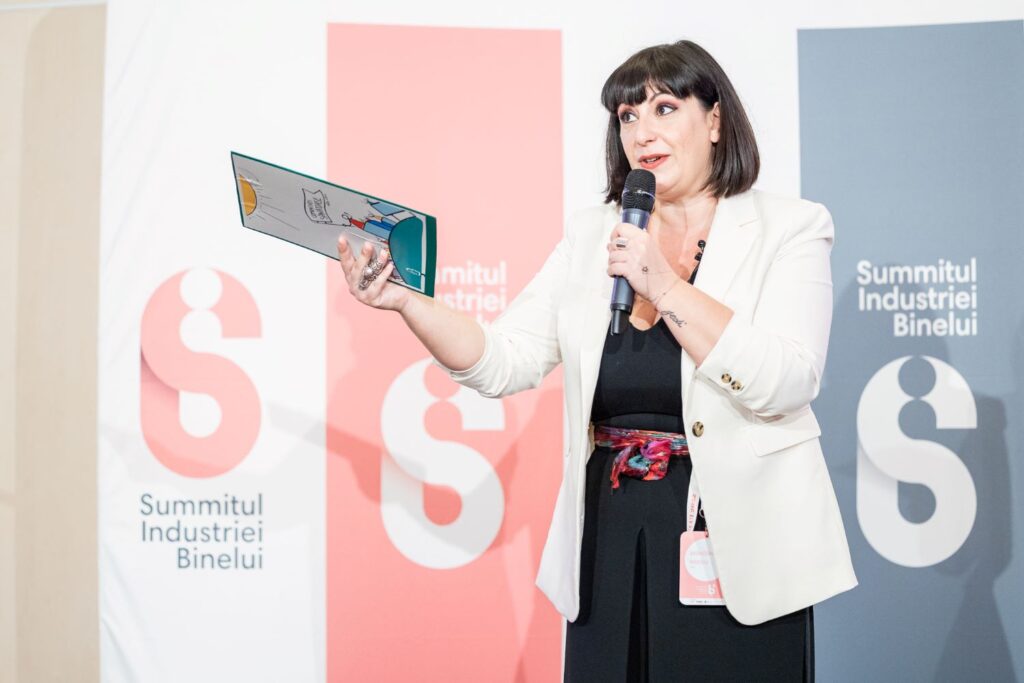
Cristina Săracu activează în zona LGBTQIA+ de la începutul anilor 2000, când subiectul era foarte greu de dus în fața publicului larg. Nici astăzi, proiectele LGBTQIA+ nu intră în topul priorităților celor care susțin mediul ONG, dintr-o falsă teamă că societatea nu e pregătită pentru acest subiect. „Schimbarea nu se întâmplă însă pur și simplu, o facem noi atunci când alegem să ne implicăm”, spune Cristina Săracu.
Fotografii din arhiva personală Cristina Săracu
De ce ai ales să te implici în acest domeniu nonguvernamental? Care a fost chemarea?
The first step in my involvement as a volunteer was somewhere in the '90s. Then it seemed as if a chasm was deepening between those with a real chance and those forgotten by society, by decision-makers, by everyone. And it wasn't just a category: there were the children for whom school became even more difficult to access, there were the elderly deprived of power and minimal resources, they were the ones discriminated against, vulnerable and always left behind.
Am simțit atunci că nu pot şi nu vreau să stau deoparte, că e nevoie de fiecare dintre noi, că orice ajutor cât de mic face undeva diferența. Mi-au rămas în memorie dorințele unor copii dintr-un sat fără drum, care îl rugau pe Moș Crăciun să le aducă săpun, un prosop, un burete de șters tabla şi cretă. Eram la primele proiecte de voluntariat…
În zona LGBTQIA+ am ajuns când am descoperit Asociația ACCEPT. La începutul anilor 2000, era un subiect tabu oriunde în societate. Acolo am fost „voluntar pe furiș”: să nu se afle la job, să nu mă știe nimeni. Încercam să ajut cu ce pot. Trăiam cu teama de a nu fi dată afară de la serviciu, erau toate fricile adunate în gândurile fiecăruia dintre noi. Aș fi vrut să pot face mai mult, într-un fel eu reușisem să-mi găsesc echilibrul, dar vedeam atât de mulți oameni aproape striviți de bătălia cu propriile trăiri şi cu mediul atât de ostil…
I don't know if it's any "calling." What I know for sure is that I can't stand aside, I can't pass by someone who needs help without caring, without trying to do something.
What does the relationship with the community look like? As part of the NGO sector, do you feel that you have been supported and understood your mission? If so, does this support also translate into concrete actions (involvement through volunteering, donations, etc.)?
Subiectul LGBTQIA+ este încă foarte complicat în societate, aproape nu vorbim despre asta. Este o comunitate profund invizibilă cu excepția celor foarte tineri, deși am tot făcut pași, deseori timizi şi cu certitudine încă prea puțini. Am văzut însă în ultimii 20 de ani cum, pe măsură ce înțeleg, oamenii trec de la neutralitate la deschidere şi uneori devin aliați ai comunității. Discuția este în fond despre drepturi, șanse egale şi nediscriminare de orice fel, dar din păcate nu avem încă dialoguri consistente despre ce înseamnă LGBTQIA+, iar informațiile sunt deseori trunchiate sau pur şi simplu neadevărate. Relația cu comunitatea din oraș, din regiune, este încă la început, punem punți şi încercăm să deschidem dialogul.
The good news is that when people are open to listen, to ask without offending, when we are listened to with the desire to understand , hostility disappears.
Solidaritatea umană nu cunoaște bariere. Am trăit asta în martie, într-o încercare de a ajuta un adăpost LGBTQIA+ de la Liov. Am avut alături oameni excepționali care ajutau oameni: Ioana Vârtosu de la Asociația Școala Mamei Junior şi o mână de oameni din toate colțurile lumii. Pentru ei era irelevant din ce minoritate fac parte cei pe care-i ajutăm. Şi așa cum știm că orice donație ajută, orice mână în plus la descărcat un tir de ajutoare înseamnă foarte mult, iar o vorbă bună spusă celui care e la capătul puterilor e neprețuită.
Despre aliați pe bune vorbesc şi imaginile de la Pride (la București, Timişoara, Cluj sau Iași). Mergeți la Pride și o să descoperiți o mulțime de aliați: mame cu copii, părinți sau bunici, prieteni, colegi, veniți cu toții alături de noi să ne susțină. Pentru mine e şi un marș al solidarității.
What do you think are, at the moment, the big obstacles for NGOs in this area?
Din perspectiva comunității LGBTQIA+ e încă mare, mare nevoie de dialog, de voci coerente şi echilibrate — cei care pun punți şi construiesc împreună o largă înțelegere a ceea ce suntem, a nevoilor reale.
The main obstacle is the lack of understanding of what it means to be an LGBTQIA+ person , plus all kinds of prejudices, stereotypes and often totally untrue information.
Şi clasica replică: „nu e momentul să vorbim despre asta, sunt teme mult mai importante”.
În plus, încă sunt foarte puține ONG-uri în domeniu.
Have you ever felt that the work your organization does is less attractive to partners and sponsors in the country? Have you received rejections from some partners?
În mod evident subiectul e mai puțin atractiv pentru partenerii și sponsorii din țară, iar replica cea mai „simpatică” e: „nu am nimic împotriva voastră, eu vă susțin, dar nu public”.
Rejections are usually a "not now" or simply lack of an answer.
În mod paradoxal, drepturile omului, cele despre care vorbim, nu intră în topul priorităților celor care susțin mediul ONG (sponsori, parteneri). Nu știu de ce limitarea drepturilor şi libertăților este privită ca un subiect secundar, deși duce la situații dramatice de multe ori.
Există o falsă teamă că societatea sau comunitatea va reacționa negativ la acest subiect (că nu e pregătită), că vor pierde din simpatie şi susținători dacă se implică ȋntr-un proiect LGBTQIA+, că „e un subiect sensibil şi mai bine îl evităm, poate peste câțiva ani va fi altfel”.
Change does NOT happen, we do it when we choose to get involved. The things we're not talking about don't work out by themselves.
But we also have to talk about the glass half full. I have met in foreign companies and very open allies, who are waging in their organizations unspoken battles to change the mindset. If we manage to have an honest and coherent dialogue, the change is obvious. I discovered openness and concrete, authentic supportive actions.
Îți vine în minte o poveste din rândul beneficiarilor voștri care să te fi marcat în acești ani și te-a făcut să continui munca?
There are many stories gathered, often the fact that things did not turn out as I had hoped became the motivation to do everything better next time, in the next project.
Am în minte o discuție cu unul dintre primele grupuri informale LGBTQIA+ din provincie. Era prin 2004, înainte de primul Pride de la București. Era mai mult un grup de prieteni care visa să schimbe lumea. Ne întrebam atunci ce putem face la Timişoara? Cum să gestionăm valurile de ură şi reacțiile acide? Păstrez în memorie imaginea unui băiat căruia ȋi era greu să spere că va fi mai bine, nu-şi găsea drumul. Era foarte tânăr şi părea doborât de reacțiile cumplite ale familiei şi nu numai. Mă întreba atunci: „De ce trebuie să mă ascund? Cu ce am greșit?”. Am petrecut seri lungi povestind, căutând răspunsuri, dar parcă găseam mai multe întrebări. El a avut noroc: este astăzi psiholog și încearcă să facă lumea mai bună.
Dar asemenea lui erau și sunt mii de oameni respinși de familie sau marginalizați de comunitatea în care trăiesc și, din păcate, nu puțini aleg sinuciderea.
Îmi amintesc însă o poveste mai recentă, de acum câțiva ani. La unul din evenimentele de la Timişoara a venit la mine un puşti. Avea vreo 17 ani, venise de la vreo 200 de km. Era pentru prima oară la un eveniment LGBTQIA+, iar poveștile de viață auzite păreau din altă lume pentru el: erau oameni care au găsit echilibrul, care au învățat cum să gestioneze durerea și presiunea socială. A venit către mine cu multe întrebări și mi-a spus atunci că este prima dată când poate vorbi deschis, fără teamă. Mi-a povestit prin ce dramă trecea acasă, cu familia, la liceu. După o cruntă bătaie „de îndreptare”, părinții îl dăduseră afară din casă, dormea la o mătușă. Mi-a rămas în memorie bucuria de o clipă din ochii lui, dar şi tristețea şi întrebarea lui ca un ecou: „Cu ce am greșit?”.
M-am gândit atunci ce diferență poate face un loc în care să te simți în siguranță, măcar pentru câteva ore, mi-am amintit ce înseamnă să nu poți vorbi cu nimeni și să trăiești însingurat cu o mulțime de întrebări.
Pentru cei ca el, o banală conversație cu părinții, care ar trebui să-i ajute, să le fie alături, este deseori doar un moment în care sunt răniți iar şi iar. Adolescenți, tineri, adulți sau seniori, toți au nevoie de o comunitate incluzivă. Poveștile lor au fost pentru mine unul din motivele care m-au determinat să ies public, să încerc să-i ajut să fie auziți, să facem împreună lucrurile să se întâmple.
#cronicidefilantropie


Marian Ursan is the Executive Director of the Carousel organization and fights for the rights of the homeless. Over the years, he says, people have become increasingly open to lend a helping hand. It was a pleasant surprise to discover this availability. However, the problems faced by vulnerable and homeless people are so serious that they need the intervention of the whole of society in order to be able to be solved.
You started working in the midst of vulnerable communities with HIV/AIDS, and then you started CAROUSEL. What was this transition like?
I didn't get away from the HIV/AIDS problem. Even though we were talking initially about everything that hiv infection means, we realized that there are categories that are much more vulnerable compared to others in the face of HIV infection.
For example, for a man who lives with HIV and eventually has access to treatment, how can he get his treatment if he is sitting on the street? Maybe he has lost his treatment, because he does not have a place to keep the pills safe. Somehow we have not re-profiled ourselves, but we have recalibrated our messages so that we are easier to understand. Let's explain that most of the time this problem is much more complex. We are also talking about the lack of identity documents or where to take a shower or where to wash some clothes, all kinds of things that affect the vulnerable.
How did you think the community would react in the beginning?
We were quite skeptical about the ability to attract resources. We realized that it's a field that's not attractive, that they're very hard-to-digest topics. We knew this and that's why we stubbornly went on to keep going in that direction.
We are talking about a social service – it must be given to the people who need it.
It's a delicate matter to promote and bring their message and problem into society. We're talking about people who face multiple vulnerabilities. Not only do they sit on the street, but they also have addiction problems, they are involved in drug use, alcohol, they do not have papers, and all this is gathered in a man you avoid on the street.
For us, at first the most important thing was to understand what was happening in communities. We knew from the very beginning that what we were going to do was to weight this trend of aggravation of the situation. It wasn't something new to us, there weren't people we didn't know.
How did the community respond to carousel's message and actions?
I was surprised to see that in most cases, I had good reactions. I was living in my movie, I was worried that people wouldn't understand. We underestimated the wider community and what we underestimated was business. We do not use public money, and then our funding option is aimed precisely at companies, individual donors and grants provided by international structures.
We really wanted to attract private resources into our work, I mean the CSR components and, with a few exceptions, it worked. I imagined that it might be a risk for companies to associate their image with phenomena like this. This is where I was wrong.

What have you learned over time about the organization?
We realized that we needed to professionalize our services even more, beyond this direct work on the ground. We realized that we needed to update our website for which at first we had no passion. I said if someone wanted to get to know us, come here. Well, I was wrong. Someone had to help us completely redo our site, we learned how to talk about our work, how to be more transparent.
What is the relationship like with partners and funders?
I have always believed and hoped that the relationship with a private financier is not limited to funding, but it means building a partnership together. We wanted people to get to know us, to know not just what we do on a certain component. We would like them to understand what we do in general in the organization, how we behave towards the needs of the people, how we try to mobilize those people to go much further, to have the strength and the confidence that they too can make a series of changes for the better.
We always invite people to get to know us, to know our work and then to talk to those we help. That way it seems to me that there's a better understanding of how we work. There is a better understanding of the needs of those people, and it also seems to me that it is a very valuable source of ideas. Of course we have to keep a balance and not turn some of these services into a kind of tourism. It's important, too, but beyond that, it's important that there's transparency in your work and those who support you come to understand what's going on with the resources that they allocate. Whether we are talking about a man who donates a pair of boots, or we are talking about a company.

Was there the same openness from individual donors?
I think the level of trust is growing and the way the wider community gets involved encourages us. This feels different in a good, positive way, from year to year. I think about the number of people who call us, I think about the messages we get, the people who apply for volunteering, because they've heard of good things that we've done.
What was your soul campaign? How did the "Radio against Loneliness" campaign start?
The moment we thought about doing a radio campaign it was a little different because we didn't say about food, clothes, but about something that has to do with people, beyond all the problems, and the trend of aloneness that is increasing from day to day.
We started distributing radios in the pandemic. If you remember, the streets were deserted except for those who had nowhere to go. There was a fantastic lack of information and all that people knew on the street is what they heard from some, from others, who were more vocal. Most of the time it wasn't valid information, we realized that people had nowhere to get information. At that time, if we talk about the Internet and TV, we know what the information was, and then we realized that the idea of radio would fit, because on the radio for now the information has remained in a correct area. How to get people to access information especially those related to covid?
We realized from their reactions that the effect was much stronger and it wasn't limited to a series of information about COVID, but rather people were saying that they were glad to hear something else, even music. In one way or another for them, being alone on the street, it was less difficult and that's when we realized that here is an aspect that somehow we neglected, not as an organization, but also as a society. In one way or another we contribute to the alienation of people.
I remember when we distributed the first radios, people kept changing stations until they came across a voice, didn't stop at the music or I know what; they listened to a voice, that's what they wanted to hear. A lot of people liked the radio theater, the stories.

What are the obstacles at the moment, for organizations like CAROUSEL?
We need a lot of things, but at the same time we are aware that the biggest and strongest wall of the past I think is the one related to how people access health services.
We all know that this problem is not one related only to a certain social category that has a significant difficulty in accessing these medical services. We all know or know someone, who was not feeling well, but thought two or three times before going to the hospital or the doctor, because he anticipated that the system was not OK, that they would not benefit from services as he would like. Here it seems to me that it is a structural deficiency, and this is reflected much more oppressively in the case of people who face poverty.
We're not just talking about the reactions of people in the system, we're also talking about how many obstacles you have before you get in front of a doctor. I am referring here to the lack of identity documents, the lack of a family doctor to prepare a referral for you, the health card, the insurances, all the barriers to which are added and the lack of empathy on the part of some. The ones in whom you put your last hope.
What stories from the community do you carry with you?
99% of stories are sad because they are stories where people die. They die alone, in the bushes, in the street, away from the people they love. We have a collection of pictures in the organization and when I go through them, they relive very difficult moments.
Ultimately, not even death plays fair with them. The people we are talking about now, no decent death can have: to be dressed, to have taken a bath, to have eaten before, to have listened to a kind word from someone. I think we have a duty to look at society as well, because for this situation, one man cannot be made responsible.
Photo source: Personal Facebook Page and Carousel
#cronicidefilantropie


Sunt în ARC de aproape 8 ani și vreo 5 din ei au fost despre fundațiile comunitare, despre ce pot eu să ofer sau despre cum pot aduce plus-valoare în activitatea lor. Vă povestesc mai jos câteva din lucrurile pe care le-am învățat.
Text by George Vlas
Fundațiile Comunitare sunt parte din comunitățile în care activează și produc schimbări pozitive, prin abordarea strategică a problemelor cu care se confruntă, fie că este vorba de educație, sănătate, mediu sau cultură. Mișcarea fundațiilor a apărut ca răspuns la aceste probleme și încearcă să se conecteze la nevoile oamenilor, contribuind la îmbunătățirea unor procese sociale sau educaționale, iar, în cele din urmă, la calitatea vieții locuitorilor. Sunt organizații orientate spre comunitate și nevoile acesteia, atrag resurse locale, constituie fonduri și reinvestesc social.
Am lucrat cu fundațiile ani buni, pe două paliere: am oferit consultanță și am colectat date despre activitatea lor, pentru a trasa niște coordonate care să arate vizual impactul pe care îl au în și asupra comunităților în care trăiesc și activează. Le-am vorbit constant despre Salesforce, cum să integreze managementul datelor în viața organizației și am încercat să le arăt utilitatea datelor.

Am încercat să văd implicarea lor în comunitate și dezvoltarea ei și dintr-o altă perspectivă, una academică. M-am orientat spre un doctorat din care să reiasă importanța lor în dezvoltarea locală. Sunt foarte puține studii și cercetări care arată impactul unor astfel de organizații în România. De aceea, nevoia de a analiza această implicare este și mai mare, pentru a identifica trenduri și modele de implicare comunitară și de a îmbogăți literatura de specialitate. Există unele statistici, însă nu avem analize științifice care să ne ajute să identificăm cauzelor care au dus la un anumit comportament sau o anumită implicare. Mai mult, nu avem alte dovezi decât ceea ce poți vedea sau ceea ce este palpabil.

Un pas spre înțelegerea rolului fundațiilor în dezvoltarea comunitară a fost realizarea unui studiu în 2021. Studiul oferă o perspectivă complexă asupra dezvoltării comunitare din România, pornind de la impactul unui fond implementat și dezvoltat de fundațiile comunitare. Mai exact, ne referim la Fondul pentru un viitor mai bun în comunitate, coordonat de Federația Fundațiile Comunitare din România și finanțat de LIDL România. Fondul a fost lansat în 2020 cu 5 fundații comunitare, iar în fiecare an mai multe fundații sunt implicate.
Acest fond nu se concentrează neapărat pe nevoile comunităților în care activează fundațiile, ci urmărește să ajungă și în comunități în care activismul comunitar este la un nivel scăzut (de exemplu, Fundația Comunitară Iași implementează acest fond în Botoșani). Prin intermediul acestui fond, organizațiile încearcă să ducă spiritul comunitar mai departe, să îl dezvolte și să creeze sau adapteze practici sănătoase de implicare din comunitățile lor și în comunitățile vecine.
Fondul se concentrează pe două domenii importante: educația și mediul înconjurător. Prin proiecte de educație informală și non-formală, membrii comunității învață cum să se implice activ, cum să interacționeze și cum să fie exemple pentru ceilalți. Totodată, învață cum să protejeze mediul înconjurător, prin proiecte locale, cu potențial de propagare la un nivel mai mare. Proiectele urmăresc crearea de mai mult spațiu verde în orașele aglomerate, mai multe locuri de relaxare, conectarea educației de mediul înconjurător sau să ofere spații de interacțiune și dezvoltare pentru tinerii din comunitate, să-i determine să se implice în comunitățile lor de la vârste cât mai mici.

Fondul pentru un viitor mai bun în comunități promovează acțiuni de implicare comunitară diverse, precum amenajarea unor grădini urbane, educația prin artă, dezvoltarea competențelor digitale, crearea unor spații comunitare incluzive sau revitalizarea cartierelor unor orașe. Iar faptul că unele fundații își orientează eforturile și în afara comunităților lor este o dovadă a interesului față de ideea de comunitate în sine, de deschidere față de potențialul unor zone și dezvoltarea acestora. Și, desigur, de a capta atenția cetățenilor și a posibililor finanțatori pentru a se implica și a genera plus-valoare în comunitățile lor, creând spațiu de colaborare și dezvoltare.
Spații din orașe, poate uitate sau care nu au reprezentat interes, devin puncte de interes pentru cetățeni și autorități, pentru viitoare finanțări și pentru utilizarea spațiilor respective în scopuri diverse, cu participarea membrilor comunității. Sunt locuri în care e posibil să existe potențial de dezvoltare, să existe mecanismele necesare și oamenii potriviți, însă să lipsească resursa financiară și viziunea de a porni o „revoluție a dezvoltării”.
How Brăila Youth Hub appeared
Fundația Comunitară Galați a implementat acest fond în Brăila. Organizația și-a orientat o parte din activitate spre o altă comunitate, un alt oraș, un alt județ; din apropiere, ce-i drept, însă o comunitate străină lor. Nevoi pe care nu le cunoșteau sau le cunoșteau mai puțin, un profil comunitar străin și oameni pe care nu îi cunoșteau. În 2020, opt organizații neguvernamentale sau grupuri de inițiativă locală au răspuns apelului fundației, au abordat și propus soluții și îmbunătățiri ale sistemului educațional local și al spațiilor verzi din oraș, o conectare între cele două, reabilitarea lor și o reconectare cu oamenii.

For the first time in Braila, a youth center was opened, which brings together groups with common interests. Olympic students, who excel in fields such as astrophysics, web design, acting, personal development, programming, but also teachers and experts, who offer their time and knowledge voluntarily, benefit, with the help of this fund, from a common space where they can express their passions and develop them. Interact with other people with common interests and passions and spend their free time in a constructive way.
Centrul este un loc incluziv, care permite tinerilor din comunitatea brăileană să-și împărtășească interese comune și să se dezvolte personal și profesional.
Centrul oferă cursuri și activități de învățare non-formală, într-un mod interactiv, prin transmiterea și sedimentarea informațiilor, alternativ sistemului public de educație, cu ajutorul și implicarea directă a tinerilor. Sesiunile de învățare și atelierele sunt adaptate vârstei celor implicați, modul de abordare este unul aplicat, care vizează utilitatea lor în viața oricărui tânăr.
Ce e și mai important este că centrul își continuă activitatea și după perioada de implementare a fondului și promovează voluntariatul, caută și adună la un loc oportunități de implicare a tinerilor în comunitate, îi informează prin intermediul paginii de socializare, se implică în discuții care țin de comunitate și nevoile ei, participă la întâlniri și forumuri pentru tineri (Forumul Tinerilor din Brăila) și organizează și campanii de strângere de fonduri pentru cauze locale (rechizite școlare pentru copii fără posibilități materiale, cadouri de Crăciun).
***
Implicarea fundațiilor comunitare în astfel de zone/orașe este necesară, în mare măsură fiindcă ONG-urile de tineret devin din ce în ce mai puține, la nivel județean, la fel și oportunitățile de voluntariat și implicare civică, dialogul structurat sau cursurile de dezvoltare personală gratuite, care sunt extrem de necesare în dezvoltarea personală și profesională a tinerilor. Prin fonduri create special pentru alte comunități, fundațiile comunitare redau oamenilor speranța că se poate, că ne putem implica, indiferent că vorbim de comunitatea în care trăim zi de zi, comunitatea de care simțim că aparținem sau o comunitate pe care o avem la suflet.
***
George Vlas is a PhD student at Babeș Bolyai University in Cluj-Napoca, and his thesis focuses on the involvement of non-governmental organizations in community development.
At the Association for Community Relations, he works as a database specialist and researcher.
#cronicidefilantropie


Text by Silvia Boeriu, Resource Center for Public Participation
Civic engagement is no longer as abstract as it was 10 years ago, when colleagues at the Resource Center for Public Participation (CeRe) were doing community organizing in neighborhoods. They said they were confused with sellers of forks, bedding or whatever else was in vogue at teleshopping. Years passed, colleagues old and new went arm in arm with hundreds of people and dozens of groups in their effort to convince the administration to solve problems in the communities. Now, in Bucharest alone, there are over 20 initiative groups that exchange experience and support each other.
"Come on you can see the trace at the mop!" said Oana Preda, executive director of CeRe and one of the people who founded the organization 14 years ago. Then it was a beautiful dream that people would organize themselves "by themselves" to make the mayors and councilors of Bucharest more attentive to the city's problems, and the concept of community organization looked more like a postcard received from America, on which it wrote "Just do it".
That's how the CeRe story began: we started doing it. I've seen the trace from the mop every time the groups and people I've learned what it's like with petition, with community mobilization, with protest or with the fierce attempts to get to council meetings have begun to trust that every little or more civic success inspires others, that these successes matter, and that. above all, it changes perceptions. It's just that the mop has to be watered all the time to keep seeing the traces, plus there are others who step more pressed and leave different traces on your mop trail. Traces that make you wonder if your effort matters and if we will ever be enough and vocal enough to cleanse the public administration of its "you can't, Mr. Citizen, we know better!"

A galactic Mr. Proper would probably tell us that even if he did the civic job along with ten trucks of mops, there would still be a lot of work to be done around the corners. No one is looking for perfection. That's what we, CeRe, are up to show what advocacy work is all about, who does it, and especially why mop footprints are important. The story now is about how civic engagement in big cities differs from that in smaller localities or villages.
For a group of women from a village in Giurgiu County, preoccupied with solving problems such as the lack of arrangement of a park and a playground in their village, the interactions with the mayor had unpleasant consequences. A representative of the city hall drew the attention of the civic ladies' partners that he was coming to check their building permits of the houses in the village, if their wives do not "let it softer". That's kind of the way it is with civism in small communities.

Everyone knows everyone and if you have "disturbing" initiatives for the people in the city hall, you find yourself not talking to you half the village anymore. At the same time, experience has shown us that in rural areas the communication of civic groups with local authorities tends to take place faster than in cities, and trust relations between group members and the community are easier to build. As in the city, however, in order to influence public decisions, the large numbers of citizens who support civic initiatives and the level at which the community feels represented by the topics chosen by the groups are equally important.
In Merișani commune, Arges County, access to public health services was much restricted for the community, especially for women with low incomes, who, although they crossed long distances in Pitesti, did not have the possibility to perform abdominal ultrasounds of pregnancy, settled by the state. It was a long way before the Pitesti County Hospital purchased an ultrasound to be available in the hospital's outpatient setting. And this service became possible after the Partner for You Association (APT) supported an intense advocacy campaign at the county level. A first for the vulnerable community in Merișani was also the APT campaign, which convinced the local authority to allocate homeland to families who were facing multiple economic and social vulnerabilities. For both endeavors, the constant involvement in advocacy actions has made possible these civic paths worthy of admiration.

The civic life in the village also has its strengths, from the perspective of the proximity of the members of the civic groups for offline work meetings, but also through the fact that the wishes expressed by the community are prioritized. In the village of Ciobotea (jud. Arges), the problem of the lack of local public transport puts in difficulty many families forced to walk long distances to get to school, jobs or other activities in the daily routine. Supported by Sorina Bunescu and the CeRe team, the young people from Ciobotea decided to bring the problem of the lack of local transport to the attention of the authorities. For months, community meetings were held to identify the most effective tactics to empower the authorities to solve the problem. Among the actions that had the greatest impact were the postcards that the young people in the group made and transmitted to the county administration. Postcards included photos and messages about the community's need for access to public transportation. Following the campaign, the County Council included in the Public Transport Plan a route that connects Ciobotea with the rest of the world.
Let's go back to the mop and its footprints. Civic engagement is leaving signs now, when people and groups manage to convince the authorities to solve various things that are not going well in communities. But the traces of the mop are also seen over time, when more and more people draw inspiration from the stories of civic success and learn from each other what it's like with participation and how they bring people together for a common cause.
There are no "recipes" that guarantee civic successes, only people who are very determined to change something. The more, the more diverse, the better. The more motivated and persistent they are, the greater the chances that their initiatives will be heard and replicated. There are individuals and groups who are looking for us to work together on their campaign plan, and other groups and organizations we stay for almost a year or two, until they manage to get their project closer to success. There are groups that we work with and that cease their activity immediately after solving the urgency of their actions, but there are also initiative groups with a few members, which turn into associations. All these initiatives are changing perceptions in the long run. Let us no longer be afraid to pull the sleeve of public authority and dare more to demand change. At Merișani and Ciobotea, trust was planted!
*Photos belong to CeRe
#cronicidefilantropie


by Bogdan Dinca
Galati has gone through two major crises in the last two years – the pandemic and the flight of Ukrainian citizens from war. The Galati Community Foundation has managed to mobilize local resources not only to cope with these crises, but also to continue projects such as the Științescu Fund and the Half Marathon, which create opportunities for education and civic initiatives.
REFUGEES SAFE
Ten children look closely at the pictures that Miroslava shows on the laptop. They are "vyshyvanka", traditional Ukrainian shirts, usually worn on holidays and special days. Anya explains the details of each suit and then shares clips with the children that they are going to color.
"All children have such costumes at home. Sometimes they talk about them with us and tell us that they lack them. That's why we wanted to do some activities with them that would remind them. They know the colors, they know the ornaments and they like to color them," says Anya. Miroslava adds: "at first, the children were talking about explosions, alarms and all these sounds. But now they are in comfortable, safe conditions, surrounded by love and kindness. It's become easier for them, they're starting to forget."
Anya and Miroslava are two of the three Ukrainian teachers employed at the "Clever Kids" kindergarten in Galați, where children who arrived here every day because of the war come every day.
In the first days of the war, Carmen Talabă, the kindergarten director, visited several refugee centers in the city and realized that she could help with what the association knows how to do best – to provide access to education to children, in this case to the Ukrainians. He launched into social media the idea of creating a class for them and the desire to find cadres from Ukraine. At first the teachers came voluntarily.
Anya is 37 years old, comes from Odessa and is a mother of two daughters. In Ukraine she has worked for the last four years as an educator in a private kindergarten and wants to use her experience to help families who left the country and stayed in Galati: "I'm staying in a shelter. At first, I did not know what to do, I had a lot of free time. Carmen told me she wanted to make a class for Ukrainian children and I wanted to help."
Fleeing the war was an experience that left traces: "I am also an artist and I usually travel a lot outside my country. But usually, when I leave, I know I'm going to come back. It's the first time in my life that I've left Ukraine and when I don't know when I'm going to come back. At first I thought it would take two to three days and it would all end. But it's not over. I left in a hurry, some friends called me and asked me if I wanted to come, we had ten minutes to decide.
No one knew where we were going, we just wanted to leave. It was hard at first. My friends left for Germany and I was left here alone. I don't want to go anywhere, I want to stay close to my country."
Kindergarten not only helps children, but also them, the adults who work there, says Anya. On her, activities with children help her give meaning to the happenings of the last few months." We play with children, sometimes they tell us funny stories. Children have this very special quality, they are not sad, they enjoy every moment. Now they don't talk about war anymore, they play, they laugh and we do the same with them."
In the first days of operation of the class for Ukrainian children, they were offered breakfast and some fruits: "We did not have funds for everything we need," says Carmen Talabă. "I applied to the Emergency Fund "Safe Refugees" of the Galati Community Foundationand now the children have all the meals included here and they do a lot of activities."
At the beginning of March, when Anya and the other Ukrainians were fleeing the war, the Galați Community Foundation team organized, together with other NGOs in the city and with the Galați Prefecture, a first meeting in which the collaboration between the authorities and the civil society to cope with the crisis was discussed. Through The Galați Customs, three to four thousand people entered every day, part of whom was looking for accommodation and needed help. The volunteers, present in customs from the first days of the war, were tired, NGOs tried to invest time and resources often beyond their capabilities, and the authorities were caught between the need for procedures and the bureaucratic process of their implementation.
Many needs arose: from the distribution of food to accommodation or transport, from the lack of translators to the necessary psychological support not only for refugees, but also for volunteers, from the lack of customs signage to the coordination of communication between volunteers and authorities. The Foundation assumed the role of mediator and organizer of these needs, by putting in contact the people, associations and institutions that offered their help, but also by granting non-reimbursable grants. Georgiana Mihailovici, vice-president of the Foundation, spoke at the timeabout the role that FCG fulfills in such a crisis:
"The role of the Community Foundation in Galați is to provide support to organizations through aid also received from Galați. Basically, individuals and legal entities contribute with funds and these donations arrive in the form of grants to the organizations at the grassroots. Now there are eight main NGOs, each responsible for a particular area. Some take care of food, others transport, accommodation, volunteers, legal assistance, medical care."
It was the first time they had sat at the same table with the authorities and coordinated their efforts.
The war in Ukraine was not the first crisis for which the Galati Community Foundation sought solutions at the local level. During the pandemic, the emergency fund "Galați in safety" was launched, through which ten hospitals in the Galati area were supported.
"In the pandemic, everyone worked as they could and chaos was created," said Georgiana Mikhailovich. "For us now it really is a very important moment that we manage to coordinate, even if we are far from perfection. We understand perfectly and those in institutions, they need procedures, they need ordinances, but until that time comes, we need food now. This is where the NGOs came in and did what they could, because in our country this legal part is much more relaxed than what happens within the institutions."
THE FANTASTICS DOWN AND THE HALF MARATHON
Mioara Munteanu is 45 years old and is an economist by profession. In 2016 she became the mother of Andrei, a child born with Down syndrome.
"Andrei is a wanted and assumed child. I knew he had Down Syndrome – I read a lot, but the reality is completely different than what is written. From the first day he was born, all I did was take care of him, because I knew he needed specialized help."
After Andrei was born, she searched in Galați for an association to help her give her child everything she needed, but she did not find it. This is how he decided to set up the association "Fantasticii Down", in which he brought a group of parents determined to improve the lives of children with this syndrome.
"I didn't think inclusion in society was going to be a problem. From a young age it seemed to me a normal child, like everyone else, but unfortunately we are criticized and judged by their physical appearance. And yes, there are still kids who look when we go to the park or to events. It probably needs to be worked in the family and in education, in order to understand what a child with a disability means. Let's not be surprised anymore, rather we ask a question. I have the patience to answer, when someone asks me about it. A lot of times people say 'but it's going to pass, right?' – so people don't know what this syndrome means. Or 'whose fault is it? Did you have anyone in the family?' This happens because of a genetic accident."
The need for communication, to turn prejudices into normality, made Mioara get involved in public events, such asthe Galați Half Marathon, organized by the Community Foundation: "that is why we participate in such events, to see our world, to get to know each other, to include ourselves. Because these kids are a little bit different, too, but they're still kids. And they know how to play, to love. And they learn, harder , but they learn."
In 2022, the association founded by Mioara participated for the fourth time in the half marathon, along with eight other causes in Galați, such as the support of children with autism or those with a parent in the penitentiary or environmental causes. The mechanism of the event is simple: you can support one of the causes registered either by running on the day of the races, or by direct donations to the cause on the site.
"At the Galați Community Foundation and at the Half Marathon we found a state of fair play. We promote our cause, we look for people to help us, they provide us with all the arsenal of communication and promotion. It seems to me an honest and clean place where people can see us. We feel like everyone else, not marginalized," says Mioara.
The association managed this year to raise almost three times as much money as it had planned. With the funds raised, Mioara aims to provide access to specialized therapies for children with Down syndrome: speech therapy, physical therapy, behavioral therapies. "A piece of the funds goes to something else. As others are kind to us, we also want to show that we can help, even if we are disabled, we can help our neighbor." Last year, the association helped with the money raised a children's ward at the hospital, with several medical devices. This year he set out to help a nursing home that has 15 seniors.
Simona Mușală, project manager of the Half Marathon, tells about what it means to organize such an event: "The work for the Half Marathon started in January, when we dealt with the formalities with the public institutions: we took the agreement in principle from the City Hall, the Gendarmerie, the Traffic Police. All permits stretch somewhere over three months. Then I chose the suppliers for T-shirts, medals, graphics. We try from year to year to be as innovative as possible and to take into account the feedback we receive over time."
Almost 150 volunteers were involved, who helped both on the day of the races and in the previous period, sharing, for example, participation kits.
ȘTIINȚESCU
In a classroom of the "Mircea Eliade" High School in Galați, twenty students of all ages listen to the physics teacher, Niculina Coman, who points to a mock-up and explains the project they have been dealing with in the last year: "Here we have a partially robotic farm, which a young farmer who does not have much funds to use. We symbolically put three cows on the conveyor belt on which the food comes. We have straw bales, fodder plants. From Lego pieces, the kids made a summer stable with vents, a fountain."
Iulian, one of the eleventh graders, the "clear head", as the teacher calls him, enthusiastically completes: "we also have solar panels, which supply electricity to a barn!"
He talks passionately about the work he has done in the project. He says that he has always wanted to build a robotic arm, but he lacked both the necessary technology (in this case a 3D printer) and the funds for electronic parts. The "Smart Farm" project, with which professor Niculina Coman applied to the Științescu Fund, ensured her access to both.
About fifty children worked on the project, who also received the help of students from the Faculty of Automatic Control and Computers. They came up with the idea of using Arduino modules instead of Lego parts and mechanisms. The children learned programming and how to combine different technologies.
One of the objectives of the program was to provide collaborative opportunities for students from as many classes as possible. For example, children from human profiles were involved, who took care of the design part, and an important part of the project was that of mentoring. Lucia and Bogdan, from the tenth grade, were also mentors for the children in the first grade. At the first meeting with the children, the two had great emotions, their voices trembled and they did not know what to expect: "The experience of mentoring was more difficult than that of a student. We didn't know if the kids understood what we were explaining to them, although we had a pretty well organized text. We had to think about how to explain them understandably, how to make them understand. I basically had a teacher experience. You have to be patient."
Iulian explains what he managed to build with his colleagues:
"We have two automated systems. The irrigation one consists of a sensor that permanently monitors the moisture level of the soil. We have a converter from analog to digital, and all Arduino modules have one bluetooth module at a time, so all the information is sent to our phones. We have a pump that we can operate using a relay or program it to activate automatically at a certain level of soil moisture."
Also through Arduino, Iulian also made his biggest project: a robotic arm that replaces the human workforce. "It's very accurate, effective, it doesn't ask for food, it's asking for money. Now it's connected to the laptop, but it can also be operated from the phone." In the future, he would like the farmer to act everything on the Internet.
Iulian most likes to combine the hardware part with the software part. "You also need knowledge of electronics, of mechanics. At first I had no idea what a relay does, but now I know it very well. In the future I would like to be a software engineer in the automotive industry. This robotics group opened my eyes, and the funding helped me the most."
Niculina Coman says about the group of students she works with that they are all dreamers. In her 32 years of education, she has constantly tried to get involved in giving children as many opportunities as possible to work practically with the notions of physics she teaches: "The mind has to keep it awake all the time. And you can't keep her awake by watching TV.
You know how school was done before, you had to deal with what you had in the lab. And I wanted these kids to have more. I like at the grassroots, to understand the children what they are doing, with a practical, palpable example. You learn the theory today, tomorrow you don't know it anymore."
She went with the kids to all sorts of competitions. He had students in the class who qualified for international Olympiads, but the lack of funds prevented them from making the trips. In time, she learned to seek funding, as is the one from the Galați Community Foundation: "I learned about the Științescu Fund from a colleague in 2019. I had the idea: the lack of parking. I talked to one of the students, with Stefan, I asked him if we could make a mock-up of the bunk parking lot. He told me yes and I applied. I learned on the fly, I made phone calls, I asked other beneficiaries of the program how they did it." At the next edition of the fund has already written the application for an environmental program, which is based on photovoltaic panels.
In the two editions so far, the Științescu Fund has financed in Galați 20 projects, in which almost 3,000 children were involved. Across the country, over 450 educational projects in science, technology, engineering and mathematics have been supported in 13 regions of the country.
GALAȚI COMMUNITY FOUNDATION
In addition to the Științescu Fund, the Half Marathon and the emergency funds opened for the crises of the last three years, the Galați Community Foundation is also carrying out other programs for the community in the city. Liliana Cristea, executive director of the foundation since 2019, explains: "Our role is as a financier, facilitator, curator of resources and opportunities. We support community transformation by engaging human potential and local resources. Our vision is a community that is aware of its potential and that explores, creates new solutions and acts collaboratively. Our goal is to make Galati at home, a 'home' from which we do not want to leave."

The Foundation appeared in 2014 as an initiative group, and in October 2015 it became a well-documented foundation, founded by people from the city, with the support of the Romanian American Foundation and the Association for Community Relations.
Today, the foundation is part of the Federation of Community Foundations in Romania, along with organizations from other 14 cities. The Federation helps local foundations to develop and professionalize themselves, by developing funding mechanisms and by supporting in various forms the national network of foundations. Some of the programs, such as the Științescu Fund, can be found in several cities, and the community foundations that are part of the network recommend each other to national funders and exchange information about their projects.
Alina Kasprovschi, director of the Bucharest Community Foundation, tells about the conditions that must exist in order to create a community foundation recognized by the federation: "One – to have a community as cohesive as possible, to have some initiatives, some people who do well and two – to have a strong enough local economy, because the community foundations are generally financially supported by local money."
This is also the case in Galati, where the Community Foundation is constantly trying to increase the involvement of local resources. If you want to support the galatian community, you can do it as a natural or legal person here.
The article was produced within the Journalism Scholarships on Philanthropy, a program developed by the Association for Community Relations and supported by Lidl Romania.
The article was published on the Documentaria.ro and can be found here (http://www.documentaria.ro/content/archives/48300 )
#cronicidefilantropie


Articol de Ruxandra Pătrașcu-Maian
Two women eat fruit fry in a bright apartment on the ninth floor. They are encircled by a time-peeled furniture, on which a bunch of polenta pots, many coffee pots and jars of chamomile tea have cooled. Cold teas are the favorite summer drink of Mrs. Elena Marin, 75 years old, this also because she thinks that the water in Bucharest is not drinkable. The cake is the delicious gift brought by Maria, 21, who wants to show her affection for her new septuagenarian friend. I look at them and remember the last coffee I drank with my grandmother before she died. From here to grandpa it's just a fracture of thought.
One of the most vivid memories I have with him is from the summer of 2020, when my dad called me worried that he wasn't answering his phone. He asked me to pay him a visit. I got to the front door and knocked three times, but nothing happened. Not even after the fingers pushed with annoyance and power into the doorbell or the fists thrown into the door. That silence raised my pulse in my throat and the commotion settled in my thoughts: "is it safe to be home? failed? why doesn't it make any noise? why not throw an object on the floor? does he hear me? is he dead?". I couldn't stand in front of the metal door until my dad arrived, so I swirled around the block with a branch in my hand, hitting all the windows of the downstairs apartment and screaming through the ajar one with the hope that maybe grandpa would make a noise to show me that he was alive, if not that, at least to know that help was on the way.
As he parked the car, Dad ran to the garage set up by grandpa where he knew he would find a metal staircase. With her in one arm he chased up to the lip of the balcony. After supporting the staircase he wrapped a piece of fabric over his hand and broke the glass. He plucked the pieces of glass that could have scratched his flesh and curled up through the metal dial. From the balcony he saw his father fall by the bedside. With his broomstick he broke the thermopane, and then he yelled at me to call the ambulance. Grandpa was conscious, but he couldn't move. That moment was the first major event that suggested that grandma's death affected him worse than we understood and that loneliness might be a threat to his life.

We age faster than ever and are not ready for it/"Time must be lived, not killed"/The decade of aging
"Loneliness feels like an end."
"It's like I'm on the bottom of the sea."
"It's like a black hole that I can't get out of."
"I have this constant feeling of killing time. The death of time... time must be lived, not killed."
"Loneliness looks and feels like a desert."
"It makes me feel like I have broken wings."
"It's a pain, not physical, but mental."
These are just some of the testimonies that people from the NGO " Never Alone" have collected from the elderly they are witnessing. Population ageing is a global phenomenon, and by 2050 the proportion of people over 60 in the world will double, from 12% to 22%. By 2030, 1 in 6 people in the world will be 60 years of age or older, according to the World Health Organization. That is why the United Nations has declared the years 2021-2030 the decade of healthy aging: it is necessary for states to rethink multiple social systems to ensure dignified aging.
By 2050, there will be almost 500,000 people in the EU who will be 100 years old. The phenomenon of an ageing population has been evident for several decades in Europe. This process is determined by the increase in life expectancy, the historically low fertility rates and, in some cases, the migration – as is the case in Romania. In our country, it is estimated that in 2050 one in four Romanians will be retired, which will make us one of the oldest companies in the EU. What are we going to do with the people we are socially isolating today, and what does decent ageing mean?
Cătălin Dinu, executive director of the NGO "Never Alone", says that the loneliness of the elderly is installed in three stages:
The MISSION of the NGO is to provide vulnerable elderly people with a dignified ageing, but also to make us, as a society, understand that people also matter after retirement.

The program of "Never Alone" focuses on the idea that each of us needs others to be seen, to have an external motivation or purpose and especially to keep us physically and mentally healthy. So they initiated a social project where people who want to, that is, volunteers, enroll in the program to create a social connection with an elderly person. Then the representatives of the organization connect the volunteer with a single old person, and the pair decides together a schedule of joint visits and activities. In 2021, the people from Never Alone, managed to be with 245 elderly people with the help of 266 volunteers. The organization does not impose specific activities and clearly emphasizes that the role of the volunteer is not that of a social worker, far from it, but simply of a man who sees himself with another man at a story, that is, two people who seek friendship.
Do you want us to be friends?
A 70-year-old woman enjoys the sunset light in Turkey's Golden Bay, with the innocence of the child who finally received the coveted gift. She can't believe it to the point where her operated legs have worn her and she feels the mistress of the world. It's 2017, and Mrs. Elena Marin had not left the country until she retired. He finally fulfills the desire of his life: traveling.

In recent years, she has been interested in two events in Bucharest: the book fair and the tourism fair. So every year he was looking to go on a trip. Turkey has whetted her appetite and shown that she is not too old to fend for herself. After a while, he found another trip to Malta where he was told that he could go, without feeling judged for the limitations with which old age comes, because the guide will take care that the group respects his rhythm. She did not have high expectations from her adventure, it was also enough for her to sit on the terrace in the sun. But after she got on the plane something changed, and when the guide told them that they would have five days with five itineraries to choose from, Mrs. Elena lifted the cane in the air and asked impatiently: "can I pay them all?". When he tells the story, he's with his mouth up to his ears: "God, when I think about how much nonsense I can do!" The excursion guide gave it as an example because it moved very well, and even went out to sea on the Blue Lagoon in Malta. "Man, and when I saw myself there, I couldn't believe it. I am from the time of the Russians!" Now, at the age of 75 and with his voice extinguished, he feeds on memories, because he is ashamed to travel again. She thinks it's a burden for others because she has moments where her knees get stuck and she has to ask for help from those around her to sit in the coach seat.
Mrs. Elena is a woman who stubbornly strives to preserve her independence and dignity in a country for which the elderly are invisible until their votes are needed. It's always been hard for her to trust people, but now she's all the more complicated at an age where she knows she's fragile and vulnerable, although she doesn't like to be perceived that way at all. Even though her body needs a cane to keep her from falling that could keep her bedridden. Mrs. Elena moves slowly and walks with difficulty, the slowness of her legs also takes her by surprise at times. In the outside world it is surrounded by possible dangers, from some poorly built stairs, a stump coming out of concrete, any unmarked unevenness or any poorly defined step can be terminal. Not for her life, but for her quality of life. And in the house he has carpets that cling to the flip-flops, but there it's easier to keep the dangers in control. Falls are among the greatest enemies of the elderly because a crack or hip fracture can irreparably affect their mobility and limit independence. In the worst case, a fall in the house can mean heart failure or a deadly blow. Fortunately, Mrs. Elena left a spare key to the neighbor across the street, at least to have someone to open the door for her in case of an emergency.
She lives on the ninth floor in a Ceausescu block, trapped in her apartment like a tailless rapunzel and no prince. Millers Park is the first view that awakens his blue eyes every morning. In the last three years he has only gone out of the house for short distances, to the store, a few necessary urban trips to the doctor. The exception was the road to Botosani, her hometown, where she had to take care of her inheritance. She feels good in her apartment in Bucharest, it's the place where she is in a physical and emotional comfort that she hardly detaches herself from. Her home has the atmosphere of a past life, perhaps because Elena says she no longer lives for any future, but only for today. The door of her apartment is decorated with crucifixes gathered from the 11 countries she visited after her retirement, while the body still did not dominate her decisions. From the memories of those years, with the crosses strung from the top of the door to its bottom, Elena made her way to the cross for the last trip. "When she burys me, I go out there," she says serenely and at peace.

Mrs. Maria Elena is the kind of elderly woman who went to an event of the Patriarchate not for the service, but to see how a drone flies. "I was curious to see how it worked. Here she is, there she is," she tells me with the smile of curiosity on her face, but she is quickly wiped out after remembering the drones in Ukraine. Before her retirement she was a biology teacher, a profession that fed her for decades, as well as the pride of being the first person in her family to take the baccalaureate and go to college.
As we talk, either at the kitchen table or at the desk in the study room, she wears her body with dignity, keeps her back straight and her blue eyes aroused and focused, and although she still runs away with words through memories, she knows where to resume her ideas without help. She doesn't smile often, she says she's been terrified since her husband's death seven years ago. That's when he felt he was on his own and he had to resist, whatever and whatever it was. She has no children, and only one brother lives from her family, often almost just by phone, but he is also too old for regular visits. It just has it on it. "I only trust these two hands. If I get tired of them, I rest and drink a little water. Sometimes they also deceive me. For now, I've done it myself, but I've started thinking about other needs. Everyone lives alone, everyone is born alone and dies alone. So don't think about others," she tells me when I tell her that I wonder how we can build more inclusive and integrative social systems for the elderly. "You don't have time, I tell you," she says with the wisdom of the man who came to terms with the idea that the present is her main ally.
In mrs. Elena Marin's life, the people from Never Alone entered through a poster pasted in the elevator. The same was true of Maria, the volunteer who for almost a year has been helping her to appease her loneliness, like a surrogate granddaughter. Loneliness increases with age, but it lives in all of us. Maria Adam is 21 years old and — when she doesn't work part-time at the Regina Maria call center — she attends post-secondary nursing classes. What brought her close to Mrs. Elena, however, was her childhood because she comes from a family with divorced parents. "I know how bad it is to be alone. I thought it's not just about how I help this woman, but that I'm helping myself, it's a mutual complement. And we can feel alone just like the elderly. It's about empathy," Maria said to me one morning over coffee.
While she was little she was staying with her grandmother, who she thinks had Alzheimer's, but who has never been diagnosed. The young volunteer intuits that the part of her that feels guilty because she was not ready to take care of her grandmother is present in the relationship with Mrs. Elena. Maria believes that her family did not understand at the time what it meant to care for a person with a neurodegenerative disease.
On her first visit to Mrs. Marin's house, the Volunteer Never Alone was two hours late because she got lost. It was her first month in Bucharest and counting on the fingers of the bus stops did not help her much, because the RATB had changed the route. Her phone screen was broken, and although she tormented her eyes with Google Maps, halfway through she also ran out of battery on her phone. "I asked from man to man where the Pantelimon hospital was, then I got to a barbershop and with my eyes in tears I asked them to charge my phone, and then I called Mrs. Elena. The poor woman was waiting for me by the door that she did not hear the intercom. It was a shameful first meeting."
Maria's story also describes the dynamics of the relationship between the two, because at first Mrs. Marin had a very difficult time letting Maria do things for her, "it took a long time to gain her trust. Now it's OK, she calls me to tell me what to buy, but before that it was very hard for me to convince her to buy her a loaf of bread, although she is moving very hard being operated on her leg." At the beginning of the visits, Mrs. Marin was skeptical and often asked Maria why she wanted to do this, what her interest was, what she wanted to achieve. She found it hard to believe that it was just volunteering, and that amused Maria because she thinks it's OK to do things without wanting to get anything.
In Maria's imagination, the interaction between them would have gone much easier with a simple reply: "Hi, I am Maria, do you want us to be friends?", but she quickly realized that she needed patience, to give Mrs. Elena the chance to settle in. "She can't be like me, she can give everything at first, she's afraid of being bad people with her." – Nelson Mandela Their relationship grew gesture by gesture, as Maria says. The first times she tried to convince her to drive her home, an initiative that Mrs. Elena bared without the right to appeal, because she is stubborn and cares about her independence, but at the same time she is shy and did not want to bother her. Maria had a hard time accepting this, but she gave Mrs. Elena space, even though she was worried about how difficult it would be for her to get home. "I'm going to learn to be more thrifty, and for her to accept to receive," and now there are still reservations between them, but they're more relaxed than in the past.
"There's no one next to her and that's the problem. We usually talk about everything we do that week and not many things happen", maria describes Mrs. Elena's loneliness. The lady's health preoccupies Maria, because she imagines the vulnerability she can feel, but also because she knows how lonely she is, so the thought of a possible depression was not far away from her. In the winter she looked for books on how depression manifests itself in the elderly, to understand what she could do and how she could be present in Mrs. Elena's life in a favorable way. "I was bringing her books because I was thinking about how to keep her busy. I couldn't stay longer with her or visit her more. I don't know how I would react if something happened to her, to know that I'm not going to her anymore or things like that. Volunteering becomes very personal and you don't see it as an obligation, it's a thing in your nature. I couldn't give up. I told her I was inviting her to the wedding," says Maria with a laugh.

"We try not to position the volunteer as a savior"
Bianca Pintilie is a program coordinator at "Never Alone" and she also has the supervision of the relationships that are formed between volunteers and the elderly, she must understand their needs and work towards fulfilling them. He knows that they need to do more for their volunteers, which is why for seven months he has been organizing an online support group in which for two hours he talks with the psychologist of the organization. Meetings with volunteers are recorded and used as a virtual library, because they can learn from them how to manage the relationship with the new people in their lives. They use guidelines on the basis of which volunteers can recognize signs of depression or dementia in the elderly, and if they notice them, they are urged to notify the NGO, which contacts their legal guardian and recommends that they consult a specialist. "We try not to position the volunteer as a savior in the relationship with the elder, but to understand that they are there to be a support. They're both equally important in this equation." It's something that he admits that they also face in NGOs, because a lot of them want to change the world, but it's essential that they understand their borders.
"It's a very hard job for us," Bianca Pintilie explains to me, on the terrace of the "Never Alone" center. It refers to the fact that working with the elderly is not only about convincing them of what they are doing, but also explaining to them what an NGO means and why there is someone who does not ask you for anything and does not want anything from you!? "It's very difficult for them to understand what volunteering means, why these people come without interest, only in their time community work was patriotic work and they were forced to do it."

Distrust is a leitmotif in our society, but it is getting worse with age. The elderly are also skeptical of their work, even if they are a registered organization, whose advertisements they see on TV and about which they can read on the Internet, the fear of being stolen or tricked is great.
To increase their trust in the organization, Bianca says, the elders need to know that there is a boss behind him, that it is an authority that protects them from possible abuse. A volunteer told Bianca that at the beginning of her relationship with the elderly woman she was visiting, she wrote down in her diary all the details about her: name, surname, age, address, details related to her financial condition, "because she wanted to make sure that she was not a person who wanted something from her, she felt the need to have a way of control".
To make them trust them more, they come up with an extra layer of confirmation — if the social worker isn't enough, you go to the program director, if that's not enough, it goes on and so on. In addition, the beneficiaries sign a social services contract before starting volunteering, which they insist that the beneficiaries read carefully, and if there is any person who does not want to sign, they withdraw because they do not want to endanger the volunteer. "We enter a man's house, you can't get in like that anyway. What if a situation arises and our volunteer has no legal basis for being there?". I ask for a criminal record of the volunteers in order to check them and create a system as safe as possible, and with the elderly who are more skeptical they go to a lawyer who guarantees them the veracity of the service contract. It is important that both parties want to participate, both the volunteer and the elder, the members of the organization do not try an absolute work of persuasion to the elders because they have done this outdone and have accepted that forcibly caring does not work.
Opening the day care center for the elderly believes it will help them build trust. "However, we ask them to let us into their personal space, it's pretty much and it's not easy. We open the door for them and maybe they open theirs too." The center — as they call it — is both the place where the NGO team works and the place where the elderly can participate in socializing activities. They did focus groups with the elderly to ask them directly what they wanted to do there, what they needed and desired from future events, a gesture that surprised many of them. "They don't have this exercise, to understand that someone asks for their opinion without any hidden intention and without punishing them if their opinion is not in line with that of those who ask for it."
"Elders need more care than they receive"
For the young woman who had no friends in the capital when she moved here, Mrs. Elena is both a grandmother and a friend, and sometimes Maria prefers interaction with her than with other people her age, because she feels more at ease in the company of the lady. Maria thinks that Mrs. Elena "simply filled that void when she had to". In addition, it connects her humor and the way she relates to life, and Maria feels that Mrs. Elena inspires and supports her to be independent. The kind of support he didn't have at home. Interacting with her helps her understand her profession better, not to dehumanize or infantilize the person in front of her, and that's an essential criterion when we relate to the elderly in our lives. The thing he understands and from the looks and words of surprise I receive on the street from strangers. One day they were walking around their arm and a gentleman made a pirouette after them and shouted to them "lady, granddaughter like this you still have!", the interaction that stole a smile from Mrs. Elena and Maria raised her eyebrows in wonder.

They don't have the same visions of life, nor could they, they were born in totally different eras. Maria wants to help people who are begging on the street, instead of what Mrs. Elena would put the police on them. But when it comes to Mary's future, they're on the same wave. "Mrs. Marin is very focused on her career," maria says, and when she knows that the volunteer has an exam, she does not receive her to visit and urges her to postpone. For her, it's important for Maria to build a life for herself, especially because she knows she's supporting herself and can't ask for money from home.
At nursing school, Maria was talking to colleagues who would like to go to pediatrics, but she seems more attracted to the geriatric area. The thought of administering treatments to children scares her, and on top of that is added the image of nervous parents. "Old people need more care and attention than they receive. They are at a point at the end where they need all the love in the world that they can receive," says the young volunteer.
Mrs. Elena says that she still has control over her mind and manages to control the loneliness with occupations around the house, but "also in Maria I put my base. In my relationship with me, the fact that he's at the nursing home was an advantage. I have been strongly individualized all my life and now I do not show myself, but maria noticed, and to depend on others comes all the more difficult for me. I don't trust either the psychologist or the priest. Manage yourself is my expression," she says.
She knows what's going on with her. She is very aware of the degradation of her body, she understands very well that it will be harder for her on her own, she also knows that memory will leave her, and that at the moment she is suspected of a neurodegenerative disease. Read about these things with the consciousness of a person who has always appreciated information and who has created a room just for study, where the ritual of the armchair to read is still alive.
"Eh, life is complicated if you start to take it seriously. I took her seriously, only seriously, that's the flaw of my life," she says in a faded voice.

Although she enjoyed her legs while she was in her retirement, and at 68 she was flying a balloon, and now she has a collection of flags from the 11 countries she has reached, she says that the transition from an active life to that of a pensioner has been difficult for her. That's why he postponed his retirement three times, he needed the idea of leaving the business to settle in it. To some extent, retirement came with an oppressive feeling, a mixture of emotions from shame, to helplessness, to insecurity and fear. She had to retire at 57-58 and when she reached the age she imagined that someone was working on her file. It can still be seen, at the window, in the office of the three-room apartment, how he shook something out the window when he heard the bell from the nearby church. "The feeling of hopelessness, of the bell, I hold it back and now, it's been 15 years since then."
The epidemic of loneliness/We live longer, but worse
Loneliness can become a new epidemic. Britain has a ministry dedicated to loneliness, Japan has an industry of searching for people who die alone in their homes, and in the United States of America an epidemic has already been declared. In our country, the data collected by those from Never Alone in partnership with Kantar (on a fairly small sample, however), shows that one in four elderly people in urban areas experience high states of loneliness, one in two people over 65 years old say they have a low level of social support or even lack, and people over the age of 75 who no longer have partners have even less support than those between the 65-75 age group. As expected, most of the support comes from your life partner, children, family or neighbors.
According to a study published in 2015, both real and perceived social isolation are associated with an increased risk of early mortality.

"Loneliness is a feeling, the perceived sensation between existing relationships and those desired by the patient. Social isolation is the objective state of having few social relationships or a rare social contact because they are sick who have social relationships, are not isolated, but still feel alone. Too often, both loneliness and social isolation are considered inevitable components of aging and not a serious and preventable problem," explains geriatrician Valer Donca. Lived over a longer period of time, loneliness increases the risk of emotional disorders such as depression, anxiety, and can also lead to substance abuse. It also has physical costs and exposes us to heart disease, strokes, hypertension, cancer, dementia and premature death. All of this actually means that it also has a pretty high economic cost on our medical systems. For example, an analysis in The New York Times estimates that social isolation and loneliness are associated with an additional $6.7 billion in Medicare spending and cost employers more than $154 billion annually in stress-related absenteeism.
"I remember the saying of a great clinician who said that a doctor is obliged to consider more than a diseased organ, more than man in his entirety, he must see man in his world", emphasizes the doctor. The feeling of loneliness is a risk factor similar to smoking 15 cigarettes a day, according to researcher Julianne Holt-Lunstad. It's also a risk factor for dementia and functional decline, meaning that an old man who sits alone may end up not doing his basic activities, the everyday ones that are essential for a truly independent living – to be able to eat alone, to dress alone, to get up out of bed, to go to the toilet alone – and the loss of these elements means the difference between living and surviving.

Romania has a chronic problem with its health workforce, but also with their distribution and mix of skills at territorial level, especially given the current demographic trends. "By 2050, more than a quarter of Romanians (27.7%) will be over 65 years old, and the proportion of those over the age of 85 is expected to increase to 8.5%, from 4.8% in 2019", writes in the study "Labor force in the field of geriatrics in Romania: the need to improve data and management". Or recent findings show that long-term care services for the elderly are underdeveloped and fragmented.
It should also be noted that geriatrics is a relatively new specialty in Romania. We have 13 faculties of public and private medicine, but only three geriatric departments, one of which — the oldest — is located in Bucharest. According to the same study, in 2018, there were only 157 practicing geriatrics and 85 geriatrics in training nationwide. Researchers warn that there is a huge difference between supply and demand for the future, when we will have more and more elderly people that we will have to take care of. In addition, professionals active in geriatrics have an uneven distribution "57 (36.3%) are settled in Bucharest, where less than a fifth of the country's population lives. The geriatricians in training present a similar model, with 50 residents in Bucharest (58.8%) of the 85 beginner doctors at national level", informs the same study.
Dr. Valer Ioan Donca, specialist in geriatrics and former Interim Manager at the Cluj Napoca Municipal Clinical Hospital, says that the geriatrics deals with the acute, chronic, preventive, recovery and terminal care of the elderly. "All these five components are essential. Unfortunately, however, in our country, the acute and preventive component, not to say the terminal one, are a little marginalized." That is, we tend to treat rather than care, which means a lower quality of life, but a higher cost of it. "Just as pediatrics is the internal medicine of the child, so geriatrics is the internal medicine of the old man. Unfortunately, a lot of people treat old people, but too few people do geriatrics," he adds. Social infrastructure should be redesigned to meet the social and medical needs of the elderly. "Neither to overload the medical system for social problems, nor the social one, all that means outpatient and family for medical problems," he points out.
"The medical system has increased life expectancy at birth by over 20 years in the last 50 years, the bad part is that healthy life expectancy has not been influenced at all. In other words, what has the medial system been able to do? To prolong the suffering somewhat", concludes Donca.

"According to demographic predictions, 2050 will be the year when Romania becomes the oldest country in Europe. All the countries in Eastern Europe are bad at this kind of indicator. That means one in four people will be in their 60s. These are some challenges from health and care systems, to anything, to what these people read, to what they buy, etc.", says researcher Loredana Ivan, president of ENAS (European Network of Aging Studies).
However, in PNRR aging is mentioned sporadically, in passages taken with copy paste that actually say nothing, but only tick some terms that need to be included. There aren't many references in the National Health Strategy 2022-2030 either, although it's better than in the NRPS, where four points per quarter of a page of this issue are dedicated. The ideas are basic and really necessary: preventive interventions to increase the quality of life, long-term care services at home, the development and implementation of national, regional and local plans for the management of the elderly and vulnerable population, the assessment of the needs of the elderly, namely the degree of dependence between the medical and social sector, the definition of individual service plans and the development of integrated health services at the level of community so that the services offered are as holistic as possible.
"The avoidable mortality rate, i.e. deaths that could have been avoided by providing optimal quality healthcare, was two and a half times higher than the EU rate in 2015. Healthcare spending is relatively low and staff shortages are still a problem", writes the very introduction to pillar 12 dedicated to health, economic, social and institutional resilience. Even if there is no clear focus on geriatrics in the NRPS, three reforms are presented which should ultimately have the effect of improving health and social services. In the coming years, more than 180 million euros will be invested in a new foundation of our social health system.
How we see the elderly and why it matters
Stereotype becomes a bias when the balance between positive and negative elements obviously tilts in favor of negative ones, from this perspective ageism becomes a vision in which elements with negative connotations predominate. For example, if you say that an elderly person is typical, it's not necessarily crappy, but if you say it's a grumpy person it becomes negative. "Visual ageism is a form of visually representing the elder in a manner that reflects a negative stereotype" that influences the behavior of both the subject and the viewer, says Loredana Ivan. "That vision of their group is externalized and others begin to share it and short- and long-term negative effects occur." For example, the elderly can more easily come to premises such as "what else should I learn this at my age?", which denotes a loss of self-confidence and of one's own individual relevance.

To see what the elder looks like through the eyes of the students, Loredana asked them to draw a portrait of an old person, so she noticed that the cane, the bringing of the back, the weight of the gait are very present. In addition, he noticed that young people represented men more positively than women, they perceive them as healthier individuals. What she says, in very patriarchal societies such as Romania, is due to the pressure felt by women to grow old by remaining young, and then obviously this is also reflected in a negative visual representation of women's aging. Comparatively, men are seen wiser and represented with more dignity. He later also asked a group of elders to draw a portrait of their age group and their depictions were not much different from those of young people, and this, Loredana says, shows that the negative stereotype is internalized.
This directly influences the well-being, that is, the psychic comfort of the individual. On the principle of "I lived my living, I ate my cornmeal, I can not go now to do sports at the stadium, I will not do any movement". On a physical level, things are even more obvious, says the researcher, for the first time in studies anorexia is recorded in the elderly, which did not exist until now, and this is due to the problematic representation in the media and advertising. Basically, the same problems that young people face due to the surreal images on social media also affect the elderly, which is why records are also recorded in aesthetic operations. "Let the elder be an elder!" the researcher says vehemently.
Another very important noxious aspect in the current discourse is putting on the individual the empowerment of aging "it is up to you to look like this, it is up to you to actively age, it's not my job as a society. That's not really the case. How to actively age if you live in miserable conditions? What if you don't have a good job? It may be up to you if you have a decent living." That's why she criticizes the concept of active ageing, because she sees it imposed by European societies and their needs to do something with old people, but "She's very sinful because she puts it on the shoulders of the individual. If you can't adapt, it's your fault. If you can't, it's your fault."
In our law, theoretically, the elderly have the right to an integrated social protection because seen as a vulnerable category, but according to the data from the Ministry of Labor and Social Solidarity, most of the asylums and hostels (licensed*) for the elderly are private, namely 614 private homes versus 152 public. And Mrs. Elena understands the situation very well when she says that "a working man should be able to afford a decent home, but we are so poor that even with large pensions we can barely afford it".

Although the services offered by Never Alone are not social work, but rather socializing, befriending and prevention, they are essential as social support. Cătălin Dinu, the executive director of the organization, believes that the pandemic has helped them because people have understood the cause of loneliness more easily because they have lived it on their own skin. "It's important to get the elderly to recognize the condition and know that they can do something and that's not how old age should be. It's easy to recognize it in yourself, but it's hard to recognize it to others."
According to an internal research of the organization, in Romania there are about 450,000 elderly people affected by loneliness. Dinu says that the first step would be to create a culture of third-age dignity, and here he thinks of their colleagues in Switzerland, who have been open for 40 years and all the time they have had few beneficiaries precisely because there is the culture of the ability of old age, "we are talking about another standard of living for sure, but the elderly have the idea that old age is one of the most beautiful periods of life. they've worked a lifetime and it's time to enjoy life." The elder is not perceived by them as a recipient of social services, but it is also a resource in the relationship with the volunteer, because there is an exchange there that is beneficial on the other side as well. On the principle of giving what you can to the community. "I see how these people change and it happens after you do some very simple, natural things that you can do with any friend. And it's not about – oh, old, vulnerable – no, there are some people who want to enjoy life", concludes Cătălin Dinu.
A rollercoaster of emotions
Maria, the "Never Alone" volunteer, does not have a fixed schedule when she goes on her weekly visit to Mrs. Mary, sometimes she stays three hours with her, another five, it depends from day to day. He calls her all the time before visiting her, to make sure he was going. Mrs. Marin is waiting for her with a list of things they have to do or the questions she has about her phone, among other things. But now the phone is her focus. "I feel like the sun is going up and I have a beautiful park in front of me and I look into the park through my phone window. I start with my health, with my illnesses, about medicines and then I wake up reading and I keep reading", describes Mrs. Marin her relationship with the phone. So Maria draws her symbols in an address book "this symbol is WiFi, this is Bluetooth, that's where you send pictures".

– Man, you didn't take it..., mrs. Elena begins a sentence that she does not have to finish because Maria understands from the first.
– Forgive me. Now. I have a notebook and every time I come to her I have to take my pulse and tension, maria explains to me amused by the ritual they have formed.
– She takes it for herself, not for me, defends Mrs. Elena. Why did you stop at 99, that suits you? The lady teases Mary while she also measures the oxygen in her blood.
– No, no, oxygen saturation fluctuates. It's normal for these values to constantly change.
– That's what I know, but I don't understand when to read. That at the voltage stops and that's it.
– It's not a huge difference, you're looking at the limits.
– Ah, where should it be? That's how I know it, but I was looking for "what it has to be" not "where it should be", Mrs. Marin replies in a serious and yet familiar manner. If you don't see her eyes sometimes it's hard for you to understand whether she's joking or not because her tonality has few inflections, maybe that's the legacy of the biology department.
"Even if I wanted to, I wouldn't be able to go to Mrs. Elena to tell her that I'm taking my boot, I'm going. Either way, even if I moved in, at least I would talk to her on the phone, I can't imagine that we would become strangers." Recently, at the end of a meeting at McDonalds, Mrs. Elena took her in her arms, kissed her on the cheek and told her that she loved her. "I couldn't believe it. I thought that moment was incredible and I didn't think it was going to happen. Sometimes it's a rollercoaster of emotions."
Articolul a fost realizat în cadrul Burselor pentru jurnalism despre filantropie, program realizat de Asociația pentru Relații Comunitare și susținut de Lidl România.
Articolul a fost publicat pe Vice.com și poate fi găsit aici.
#cronicidefilantropie


by Alexandra Filip
Denisa finally took "some things for high school", Andreea managed to pay almost entirely for her home and canteen, and Andrei already had four personal painting exhibitions at the beginning of the year, which she could not have done without the money received from the Scholarship Fund. There are only three of the 766 students financially supported so far by the donors from Iasi, through this program of the Iasi Community Foundation (FCI), which started with a handful of friends who set out to help five students who are good at learning to perform. Since then, 10 years have passed, the five beneficiaries have become several hundred, long-distance donors have turned into mentors, and some scholars are already thinking about how they will help in turn. Together, they form a web of altruists of Iasi, linked together by the generosity to give time, energy and money. A chance for a gifted student who would otherwise get lost under the burden of the need for books and materials and the provision of daily living.

As every December, in a large hall, in a select place of Iasi, children, parents and generous gathered. It's the launch gala of the Scholarship Fund, the moment when, after a matching process, donors and fellows finally know each other face to face. Emotions and awkwardness are on both sides, but they go when they start participating in a game and when they exchange phone numbers and emails. That, when it's not the peak of the pandemic. When it's, everything moves on zoom, in one-on-one meetings and whatsapp groups. The fellows, new or old, shy, dreamy, already know that the stock market is going to get rid of some hardships. Donors, new or old, are perhaps thinking about future challenges and whether or not to lead the role of mentor. What is certain is that they will give wings to children with averages above 9 and an income per family member of no more than 1,000 lei, and the even better part is that they will be able to see, first of all, how their involvement helps.
"I feel that I have received happiness," says Denisa Mardar, who took a merit scholarship in all the years she was a student at the "Octav Băncilă" National College of Art, in Iasi, at the fine art department. "This scholarship saved me from some very high costs", says about the 1,800 lei that were transferred to him in installments, every year of high school.

When I talk to Denisa, she informs me from the start that she is more introverted, that she is afraid of being judged, of not stuttering, first of all, but she speaks with the enthusiasm of a warm summer rain. "I was happy when I was selected, that I knew for sure that if I received this scholarship, I could continue my studies well, not to have very big financial problems. I needed painting materials a lot, at least the ones we used were very expensive, I also helped my grandmother in the scholarship. I also stayed at the dorm in the 9th grade, and my grandparents had nowhere to pay me."
In the 7th grade she was determined to give to an arts high school, in the 8th she already went to a workshop of aesthetics and iconography, where she learned to paint icons, and in the 10th she learned to sew men's shirts. Naturally, he is now studying at the Faculty of Orthodox Theology in Iasi, in the department of sacred art. She could become a fine arts teacher. Or he'll work in a painting workshop. Or maybe in a sewing one — he's going to decide. Arriving at the university, Denisa no longer receives a scholarship from FCI, but the donor she had and whom she would have liked to know more, Mrs. Crenguța, who is a doctor, is now donating for her cousin, Gabriela.
Denisa also told gabriela Mardar of the opportunity, who is in high school in the 11th grade and receives the FCI scholarship of merit since she was in the 8th. He made his first years of gymnasium in the countryside, in the village of Scheia, and then he went with his parents to learn, in Iasi. "The scholarship helped me a lot, because I come from a family with shortcomings, I also stayed with rent when I arrived in Iasi", gabriela says quickly. She is technically Denisa's aunt, but the girls grew up together, "like two cousins." They took care of Denisa after her biological mother left her and remarried, and the father never knew her.
A generous database
"It is important to know from the beginning the situation at home, that it is often reflected in the respective student," says Claudia Samoila, the project coordinator in session 8 and 9, plus the last session, before going on pregnancy risk leave. Many of the fellows with high backgrounds, but precarious situations, come from the Bucium Placement Center, which also functions as a social center and as a center of excellence and where children end up orphaned by a parent or both, or who no longer talk to their parents and have run away from home. "We go there with a donor, to see his fellow, and at the center you see them all, they take you in their arms, 'lady, lady, lady!' They can't wait to interact," says Claudia Samoila.

A year of scholarship lasts as long as a school year, students receive the first tranche of money in January, and the last — in November. First, however, you need to find the brilliant students who are studying in the city of Iasi and need a chance. For this, FCI scours the database of contacts gathered throughout the year and sends a press release: to schools, school inspectorate, teachers, NGOs, school counselors, old and current scholars, on social networks, volunteer groups and about wherever students are found.
In order to become scholarship holders in the Scholarship Fund, they must meet some conditions: the semi-annual average must be over 9, the average income per head of family should not exceed 1,000 lei, and the child must be involved in extracurricular activities, competitions, Olympiads, volunteering, etc.
Those selected have the chance to receive either a merit scholarship (children in grades 5-12, with very good results at school) or performance (students in grades 1-12, who excel in a certain field, regardless of age, and to whom family income is no longer taken into account, because the costs are very high anyway). "Most of them come from theoretical high schools, not technological ones, that is, from good high schools, because there they are taught and have high averages, they are good children," adds Claudia.
Sometimes, it happens that the average of a scholar falls below 9, as was the case with a student in the 9th session, in the 11th grade, who remained a corigent in mathematics. "We met with him, let's try to find out what the problem is and how we can solve it. I had a math teacher in the database that I talked to, and she agreed to do tutoring with him once a week. Now she's in college," Claudia recalls.
Other times, some children lose their scholarship. It was the case of a girl already in the 12th grade, who was studying at a technological high school in Iasi, with a difficult financial situation at home and whom her parents could not keep at home. Unfortunately, he dropped out of high school and went abroad.
Andreea Lupu is a happy case. He found out about the stock market by chance last year and narrowly gathered all the necessary paperwork. Now she is in the 11th grade at a vocational high school of painting, the Orthodox Theological Seminary in Iasi. Here he learns about cultural heritage, art objects, the history of the art of the study of colors and technical drawing, paints icons, sketches and bodies.
With the money received from the donor, plus those from the merit scholarship at school (50 lei per month, for those with averages from 9.50 upwards) and the high school money (250 lei per month), Andreea breathes a sigh of relief: she managed to pay, almost entirely, her home and canteen, and to cover a part of the material money.
Those who give are those who, at some point, have received
Phase two: the donors are being sought. Fundraising campaigns are made, old donors are asked if they want to continue, calls are issued to convince new ones, discussions are made with companies, and sometimes even current donors become fundraisers and bring their friends, colleagues, acquaintances into the project. They donate their birthday or participate in Swimathon, an event started in many cities in the country and beyond, through which funds are raised for various causes and programs.
Those who give are the ones who, at some point, received, is the theory of Corina Farcas, the one who dealt, for a while, with raising funds and finding donors. "Where do you get the resources?" is the question he went with in 2019 to the donors, aiming to find out from whom they received them and what is their relationship with education, with school, with education, with a favorite teacher.
"When I asked them about resources, I did not refer only to who gave you 10 lei and sent you to buy what you wanted, but to who gave you a hug when you were a child, what person marked you, what words, what teachers, something you remember in an instant and after 30 years," Corina says about the first campaign made for the Scholarship Fund. It was happening in 2019, and although the campaign was a success, 2020 followed and the pandemic that would give everyone the ordinance of life over their heads.
Because it has been a tough year, with donors no longer able to afford to donate and with children affected by moving school online and isolating behind screens, the number of scholarships has declined. They were at least hoping to find donors for the 88 scholarship holders who remained in the program and who were not in their final year of high school. "The program was a setback in 2020, but we saw it as a win, that it was a tough year, we did not expect to have donors for them. But although the number of scholarships has decreased, we have maintained more donors willing to continue donating than in other years," says Corina Farcas. "Moreover, it was announced at the foundation what children do not have a tablet, phones or laptop, and the donors jumped to the rescue almost every time and donated laptops for them," says Claudia.
At the first session of the scholarship fund, five students were selected, and in session 2, which was held in the same year, there were 11. Then 30, 67, 82, 66, 106, 123, 103, 88 and 85, this year. It reached 766 children, some of whom benefited from the scholarship several sessions in a row. The Foundation linked the relationship with the fellows and donors, from how they were first selected and transparency towards others, believes Ciprian-Mihai Păius, executive director of FCI, especially since many donors have also become ambassadors of the program.
A donor offers the amount of 2,200 lei, of which 1,800 lei go to the stock market, and 400 lei covers the costs of the foundation for the administration of the program. He knows what the money is being spent on, as at the end of the semester, students are forced to send a report in which they justify their expenses, as well as a letter of thanks.
In happy cases, the donation contract continues even after it has expired on paper
Ideally, after a fundraising campaign, there are enough donors for all the children who have submitted their applications for the scholarship, and on their table, along with the letter of intent through which the little ones say why they think they deserve to be selected, a profile of them, made by the foundation after an interview, arrives.
"As a rule, we talk to the donor beforehand, maybe one wants a child who is passionate about mathematics. Or just orphaned scholars of mother or father, because he has been through this situation and wants to help. We have donors who only want girls, not boys. Or to be in 9th grade, so she could take them all the way to the 12th. A donor, just this year, wanted a student who was passionate about the kitchen.
"It's easier to do matching when you have these preferences," explains Claudia. Even so, at each edition, there are still ten or fifteen students who apply, but do not meet the requirements, there is no compatibility or do not choose their donors. In such cases, when fates smile, discussions with individual companies or donors are opened, and the fundraising session is extended until January. The launch gala is also the moment when the fellows and donors sign a contract, and in happy cases, the help for children continues when they reach college, even if the signed paper has expired.
"Usually, donors go on social cases, very few on performance, that's why the number of performance scholarships has decreased", says Claudia and reminds of Ana Târzianu, performance dancer who received scholarship from session 4 to the 11th edition, brothers Câdu and Amalia and Cosmin Stan, with fencing performances, brilliant chess students, cello, painting, music (1st place in the zonal phase and 2nd place in the national team), tennis (the respective scholarship was ranked 50th nationally, in the 16-year-old category, and she was 14 years old).
Among them and Andrei Pennazio, who since the beginning of the year has already had four personal exhibitions of painting. Andrei is 16 years old, he studies industrial design at the "Octav Băncilă" Art High School in Iasi and he had exhibitions in almost all the big cities in the country, but also in Italy, France, Bulgaria, the Republic of Moldova and China, where he represented Romania in an exhibition to which all the former communist countries were invited. He doesn't have anyone in his family with artistic inclinations, maybe a more distant uncle who, at one point, was at an art high school. From a very young age he painted on the sheet, at 9 years old on canvas, at 10 he started seriously, and at 11 he had his first exhibition.

Just when he returned from Florence on April 20, followed the theses, then the exhibition in Cluj, he returned and had to give the works to a specialty on drawing, in order to finish his averages. "I have to organize myself in advance and make a structured schedule, that from 9 to 13 I paint, then I start school, lucky that I sit next to it and get there quickly, until 19 am, I get home, I do my homework or, if I have something to finish drawing for school, I continue, I go to bed and I start again. It depends on how I have the hours, that sometimes I have in the morning, but for the most part this is what my schedule looks like", andrei recites a schedule that does not happen to spoil. Good luck to mom, who is in charge of organizing exhibitions, thinks about trips and the rest of things, what scholarships and other opportunities to find for her son.
A small donation to supplement other donations
This year we have celebrated 10 years both since the Scholarship Fund exists and since the foundation of the Iasi Community Foundation. "How we started on the road is not necessarily and how we got to the 11th edition, says Ciprian-Mihai Păiuș. " What we identified for the beginning, as a need, was to support children who perform and that not necessarily everyone supports, because most of them are inclined to go to social need. Those who perform come from much better families from a financial point of view, but performance costs, many people end up not doing it precisely because they can't afford it, not because they wouldn't have talent or work ethic there," ciprian explains.

Thus, the program was, at the beginning, one of performance scholarships, and the first five scholarships were given through the contribution of several donors, the resources being gathered during the Drag de Iasi gala. Alina Avătămăniței remembers that the five were a very diverse group: she remembers a young artist, a young woman passionate about biology who participated in many competitions and Olympiads. They made the selection according to the recommendations of some teachers who knew their potential.
Alina is an individual donor, but also a member of the foundation's board, since the time when FCI was, rather, an initiative group. "The gala was the moment when the last necessary money could be raised through which to set up, because, from the discussions we had at that time, it was quite difficult to understand and trust the mechanism that a community foundation offers, to raise money, not to implement the foundation projects, but to finance other NGOs and initiative groups to make projects", says Alina, who also donated to scholarships that night.
It was also natural for him to do it, she thinks. It was a small donation to complement other donations, and the act of providing support to the fund and the foundation came by itself. It was in line with the mission of the scholarship fund, as Alina understood it, to make it clear "that we are here to support Iasi and, implicitly, the young people in Iasi, that we want to finance projects and support scholarships, so as to offer them the necessary substance and support to transform the community in time.
Ciprian also talks about the construction of Iasi, and at the Gala he understood that there are people in the community who appreciate the need for value, "who identify with the young people who perform, who see, eventually, a potential brand of the city, in this area of excellence". A goal was slowly, slowly coming together: to form a network of altruists, investing in those who will give shape to the Iasi of tomorrow.
Not all donors can be mentors. Nor should they
The idea of the fund has not changed over time, but it has transformed. First there were the merit scholarships. Then, in order to satisfy both the need to receive and give more than just financial support, the mentoring component was also introduced. "'I have a computer, a phone, is there any child who needs this?', 'But tell him he can write to me or call me at any time!' Do you know how many times I got this message? People want to be mentors, they want to be useful, but someone has to ask for it", believes Corina Farcas.
On her first scholarship, a shy young woman who wanted to learn piano, Alina Avătămăniței remembers that she helped her financially and with advice, "and this mattered the most, the fact that I trusted her, I supported her. I came up with this idea then that, look, I was able to help, to put a brick that changed maybe a route."

To do something that mattered so much that it would change someone's life she wanted all the time, plus in the family history she was a grandmother who wanted to go to school and become an educator, but she could not, due to lack of resources. Alina understood that donating can change the grandmother's story, and help is more effective when you go deeper, to the real needs of the child, and when there is continuity.
Now she's donating for a 7th grade boy, passionate about anatomy, whom she met this year, and the challenge is to guide her steps towards his dream of being a doctor. "I haven't told him yet, but I want to let him know that I'm with him in the long run, whatever happens. An anchor of stability, that you can't have an impact when you support a child for only one year", believes Alina, who also supported the first scholarship until she was nearing the completion of college.
Navigating the emotional map and needs of a teenager is not easy, so not everyone can be a mentor. For a short time, the program also included counseling sessions with a psychotherapist, precisely to teach scholars and donors how to manage a mentee-mentor relationship. Over time, however, interest and enthusiasm waned: although curious at first, the fellows realized that there was extra time to consume, and many donors found out that it was not necessarily their vocation. In addition, the compatibility between the parties has also had its say, although there are scholars who would have liked to have come closer to donors, and donors who are afraid of insisting, when they tell their children that they can call them at any time.
That is why, currently, those who want to assume the role of mentor can also help themselves with a guide uploaded on the foundation's website, and the sessions with the psychotherapist have been replaced by training activities on various objectives, personal development, socialization, self-knowledge, openness of professional horizons. "What matters is that they do not feel that they are being given or that they are being assisted, but rather see it as a recognition of their efforts, of their work, of perseverance. We try to encourage them and show them that we support them for who they are and not necessarily for where they are now alive, that maybe they have less than others," says Ciprian, who is also a donor, but avoided the role of mentor.
He neither had a mentor, nor did he like what he saw in others. "I realized that some mentors were very self-centered: if they roasted themselves at some point on a thing, they wanted to explain to the fellow how not to get cold. Or teach a young man at an early age how to plan his budget and other savings. It didn't necessarily seem to me that this should be the approach," he explains.
About the pressures that some scholars feel, "that they are somehow 100% owed to have some results", stefan Ciobăniță also speaks, even if he did not feel it "really like that". He was a scholar for three years, when he was a student at the "Gheorghe Asachi" Technical College in Iasi, and now he is a student of Architecture in Bucharest.
In addition to architecture, Stefan also deals with fine art, graphic drawing, painting, he had exhibitions, he learned on his own, in high school, he didn't even know that he had talent, but now he talks to you about how drawing is a process, you teach your hand and muscles to make certain movements, you increase your ability to understand what you see, how light and shadow work. you work with the space. Simple, right? He sympathized with his donors, a couple "crowded enough", but with whom he met several times.
"The first time I managed to carry them and works, but I was at the beginning, I was just drawing, woe to my head," he recalls. Then he had works, exhibited, took awards and was always congratulated and supported. "Somehow, when someone gives you something, it's such a pressure that, ok, that man has to see that, nah, he didn't offer that something for nothing. Congratulating me, it was a confirmation that they are satisfied and do not have a minus in their account in vain."
When he has the opportunity, he will surely support someone through scholarship, especially if he is passionate about fine arts. "It's this thing that, eh, you starve to death with art and I'm sure there are brilliant people who aren't supported, and a scholarship would help tremendously. And two, three I would help, I find it brilliant to be able to support someone like that," says Stefan, communicating with his hands.
The network of altruists of Iasi
So, in all this geography, has that network of altruists, donors and mentors who, through philanthropy, have managed to be directly involved in the development of the people who will form the Iasi of tomorrow? Yes, Claudia thinks, because there is already a fairly large network of people who are actively involved. Corina is of the same opinion, but for her, the network is a living one, which must be maintained more by the foundation, so as not to break the ties. For Ciprian, the goal is an ongoing one, it is, rather, about the process than the result, although the results show that some donors have been in the program for years, and many scholars already know that they will donate. Theodora Irimia really does that.

On it, the scholarship she received two years helped her learn Korean. He paid for his courses, studied for three years, a year he also taught, and in college he went, with Erasmus, to South Korea. "In hindsight, the fact that I had a scholarship then and was able to do classes really helped me get where I wanted to go, after all." Now, Teodora works in a company that has a Korean product, who was looking for someone who would get along better with the customer and says that, "what I do now is exactly what I have always liked". When he was in high school, however, the road was not as clear. To go to college? But if he's not going to like it. Better stay in nature, in the countryside.
Discussions with the mentor, who lived outside and with whom she kept in touch online, helped her. "I was actually looking recently at the exchange of emails and many of the tips he was giving me at the time I applied them." – Nelson Mandela To find something she's good at, then to see if she likes it, to write to someone in the field she'd like to work in, even if she's anxious — it's stuff that she hasn't forgotten and that she's used. "In the end, it helped me make a decision, not to be afraid, to go to college." – Nelson Mandela
In 2019, Theodora felt it was time to finally do what she had wanted since she was a scholar, to give herself, in turn. "I was thinking that I am 23 years old, maybe I am too young, I have nothing to teach them. In the end, however, it matters any kind of interaction, at least of encouragement, to know that what they are doing is good, that if they come from unfavorable conditions, it will be better in the future than now. For 2 years she was a 5th grade girl, who came from a disorganized family and stayed at the Bucium center and would have continued with her, but the girl was taken from the center and the communication was lost. "It was explained to me that, being at the center, immediately a parent can come, take the child, there is no contact."

This year, she is the donor of an 8th girl, with whom she has not yet been able to communicate much, something she will work on, because she knows, since she was a scholar, what a shame it was to write to the donor, but how important is a good communication, besides financial aid.
"I remember that I had some thoughts when I was a scholar, I couldn't wait to get big, to be a donor myself. Once upon a time, I didn't know how, when, how fast. I like to give, not necessarily that this makes me feel better, but I think that's what I'm in the world for, to give, that something better maybe I don't know how to do", teodora thinks. "It feels like FCI has made a community."
"The article was made within the Journalism Scholarships on Philanthropy, a program developed by the Association for Community Relations and supported by Lidl Romania"
The article was published on the Presshub platform and can be found here.
#cronicidefilantropie


by Cătălin Hopulele
The Bethany Foundation was to open in July in Iasi the first "Community Center for Children and Families in Ukraine". But refugee families began to come, by the dozens, as early as June, to the center, in search of a place to spend time with other people like them, who were fleeing to Romania by an unjust war. Children learn English and Romanian, run barefoot in the hallways, paint with their mothers, and families receive psychological, legal or social assistance. When the enthusiasm of the thousands of Romanians who set out for the borders in February to help their neighbors faded almost completely, the refugees found at the center on the outskirts of Iasi a trace of normality of life that their children could have had in the bomb-crushed cities of Ukraine.
A large gym-type hall with a parking lot of several hundred empty seats, except for a handful of cars scattered in front, most of them with Ukrainian numbers. The image of children playing with badminton paddles is seen distorted by heat waves raised from the asphalt, like a distant oasis in a hallucination in the desert.
In fact, the oasis does exist, and many Ukrainians initially seemed truly a vision. This corner of the Agora event center, on the outskirts of Iasi, was arranged by the Bethany Foundation in a "Community Center for Children and Families in Ukraine". An oasis in the country they left behind, chased by a bloody war and the rockets and shells falling on their and neighbors' blocks.
At the center in Iasi come mothers who have no one to leave their children with when they go to the jobs they found in the capital of Moldova. Children come who want to play and speak in the language of the country where they were born, but also to learn English and Romanian. But the great advantage of the center is the community it creates, says Anna, a 34-year-old Ukrainian woman from the Odessa region, settled for over 4 months in Iasi.
44 hours, the flight from Odessa to Iasi
Anna arrived in Iasi from Odessa, after a 44-hour journey that took her through the Republic of Moldova, with her mother and two daughters, the oldest of 10 years. They were all sleeping at home when the first missiles fell in Ukraine. They lasted in the Black Sea town for only a week, until they could see from the beach the dozens of Russian ships approaching from the horizon line.
"I decided, unfortunately, to leave my city. I didn't want to do that at all. I'll never forget how much we were scared of the ships, how we saw them from shore, and how we left. First I wanted to go further away from Iasi, but I met some good people here and I decided to stay," says Anna.

The woman gathers as she tells the story, under the smile still hiding the surprise of living for 4 months in another country. Anna, however, is glad that at the time of the war her husband was abroad, being a sailor on an oil tanker. Her contract has ended in the meantime, and for a month the family has been completed in Iasi. "That makes me really happy," says Anna, while spying through the glass walls on the class of Ukrainian children who are still struggling with English exercises.
"I don't know how to tell you: I met very nice people in Iasi, very good, but I felt the need to talk to my Ukrainians, to my people. We feel that the world no longer needs us, that we are strangers here, but Bethany basically told us 'Ukrainians, we are with you, we help you, you can stay here as long as you need'."
Refugees arrived at the center before the furniture
The center started operating at full capacity in July, even though the modular furniture ordered for each room has not yet arrived. But there were nearly 100 Ukrainians, mothers and children, who attended events week after week and throughout the month of June.
Mothers and children can participate in painting workshops, where they spend a few hours together, in English language classes for adults and children, held by Anna herself, who was hired as an English teacher in Bethany and works in this center.
Incidentally, one of the center's glass-walled offices is also a virtual classroom, where children and teenagers will be able to go to the online school organized in Ukraine. Bethany is going to buy laptops and tablets connected to the Internet, as well as all kinds of school supplies and educational materials.

Refugees who need to solve some of their administrative problems also benefit from free legal, social assistance, and now the organization is looking for a psychologist who will speak ukrainian native, because it is the only interaction that they do not want to mediate the translator hired full-time.
"There is a need for intimacy to psychological assistance, there must be interaction only between the beneficiary and the specialist, otherwise it becomes uncomfortable. But this month I hope to find a specialist from Ukraine and to be able to offer this type of service as well. For teenagers we have a collaboration with the Rotary club: I make meetings with them, boardgames, film evenings. The goal is to put them together, to interact with our teams of specialists. We are also preparing a summer school for them soon", says Diana Păiuș, manager at Bethany Social Services Foundation.
In parallel, Diana says that they are looking to hire a Romanian language teacher, a native Ukrainian speaker, in order to be able to better manage educational activities within the center in the autumn. One of the plans is to open an afterschool within the center, but they are also waiting to see what are the exact needs of the mothers who arrived in Iasi. Because beyond the trauma caused by the war and the day-to-day problems, including financial ones, mothers have had their entire support system destroyed.
"The biggest problem is the language barrier: few of them know English, that's why in our team we currently have a full-time translator and we will also need a part-time translator, who participates in all the workshops that involve interaction. But a major problem is related to single-parent families, and most of them are, where mothers want to go to work, but do not have solutions for integrating the child into school or kindergarten. They do not have a support network in Iasi, in Ukraine they had a family, a grandmother, a solution was found; but that will be problematic in the long run," explains Diana.
"We are especially glad that we have somewhere to leave the children"
There is also the question of trust: if at first the support of the Romanians was emotionally overwhelming for the refugees, now the emotions have tempered considerably, and the initiatives to support the Ukrainians have remained very few. Especially on the integration side. That is why Diana estimates that there will be activity at the center for at least two years, during which time she wants to turn the workshops into an option to spend time for children in a safe place, in learning spaces where knowledge can accumulate and where they can manage their emotions without fear.

Refugees who need to solve some of their administrative problems also benefit from free legal, social assistance, and now the organization is looking for a psychologist who will speak ukrainian native, because it is the only interaction that they do not want to mediate the translator hired full-time.
"There is a need for intimacy to psychological assistance, there must be interaction only between the beneficiary and the specialist, otherwise it becomes uncomfortable. But this month I hope to find a specialist from Ukraine and to be able to offer this type of service as well. For teenagers we have a collaboration with the Rotary club: I make meetings with them, boardgames, film evenings. The goal is to put them together, to interact with our teams of specialists. We are also preparing a summer school for them soon", says Diana Păiuș, manager at Bethany Social Services Foundation.
In parallel, Diana says that they are looking to hire a Romanian language teacher, a native Ukrainian speaker, in order to be able to better manage educational activities within the center in the autumn. One of the plans is to open an afterschool within the center, but they are also waiting to see what are the exact needs of the mothers who arrived in Iasi. Because beyond the trauma caused by the war and the day-to-day problems, including financial ones, mothers have had their entire support system destroyed.
"The biggest problem is the language barrier: few of them know English, that's why in our team we currently have a full-time translator and we will also need a part-time translator, who participates in all the workshops that involve interaction. But a major problem is related to single-parent families, and most of them are, where mothers want to go to work, but do not have solutions for integrating the child into school or kindergarten. They do not have a support network in Iasi, in Ukraine they had a family, a grandmother, a solution was found; but that will be problematic in the long run," explains Diana.
"We are especially glad that we have somewhere to leave the children"
There is also the question of trust: if at first the support of the Romanians was emotionally overwhelming for the refugees, now the emotions have tempered considerably, and the initiatives to support the Ukrainians have remained very few. Especially on the integration side. That is why Diana estimates that there will be activity at the center for at least two years, during which time she wants to turn the workshops into an option to spend time for children in a safe place, in learning spaces where knowledge can accumulate and where they can manage their emotions without fear.

"No matter how small the children are, they have experienced a major stress that feels like a trauma. It takes a safe space for them to interact with other children, with trusted people. That's our hope that we can offer them in the next two years, but that's only if things evolve for better or for worse," explains Diana.
And the greatest joy of mothers is the fact that they can sometimes take a few hours for them, in which they can suffer from homesickness or in which they can enjoy Iasi, without transmitting any negative emotions to their children.
"We are especially glad that we have somewhere to leave the children ... For us mothers, it is very important. There are mothers who want to work or those who lived in a family where someone always helped them, either husband or mother, but here they are alone with their children and sometimes they need to rest. They can bring their children here, we have 2 classes, they can go somewhere to clear their minds, especially if they always had help before," says Anna, smiling complicitly. "I know many women who need such a moment to clear their minds. I am one of them."
On one of the first days of the center's opening, a waterfall-like noise resounding in the hallway between the glass-walled offices struck Diana. There were dozens of children running barefoot on the tiles, sticking from side to side, laughing and yelling at each other. I also saw them in front of the center, shod this time, accompanied by two mothers and a volunteer. They had thrown their backpacks on the run like after a day of school, supported by the wall of the building, and played badminton, hopscotch, drew on the asphalt. It was their oasis of normalcy.
The schedule of the center is set periodically, but every day there are employees there who can support mothers with their problems. And at the end of all the events, the lunch is taken right in the event center, with the expenses incurred by the NGO from Iasi.
A medium-term plan for refugees made shortly after the invasion
I spoke to Diana at the end of February, in the first days after the start of the war in Ukraine, when the flow of refugees in Romania was in the order of tens of thousands a day and the authorities were outdated. Ever since then, Bethany has been among the organizations that have not run directly into customs with help, where there were dozens of other NGOs and hundreds of volunteers. In Iasi, they ensured the operation of a transit center for refugees who needed to stay only for a few nights in Romania, until they went on to other countries where they had relatives. There were over 300 people who slept in the spaces arranged by them.
But as early as March, he started devising a plan to answer the question: "what will those who, however, not only want to go through Romania do?". Especially children, who needed a safe environment, but also education. The question is not solved until the end even today, because since the autumn the Ministry of Education has not announced a concrete plan for the organization of classes taught in Ukrainian, so most mothers in Iasi will send their children for another year to the online school organized in Ukraine.
"We have been helped by our Partners Bethany in the US, who have a great deal of experience in interventions in Colombia and Ethiopia, where long wars are being waged. From their experience we expect the integration phase to last five years for everything that Ukraine stands for. Even if the military confrontation ends, there will be a need for reconstruction, you can not say that today peace is declared and the next day the people return," says Diana.
However, she also noticed an interesting trend among ukrainian mothers, beneficiaries of the center. A large part of them aim to stay for a longer period in Iasi, maybe even forever, especially when they think about how their children will be affected if they return to live among the ruins. "Two mothers wondered: 'what childhood can I give my little girl when all she will see on the street are craters, rubble and signs of bombing and war?' So some of them might stay, especially if they're integrated into the work and start to make a point here," manager Bethany said.
The Centre, aggregator and for smaller NGOs
The centre was intended to be an aggregator for good initiatives in society from the very beginning. So I met Lucian Grigorescu, the president of the Association Together for Miroslava, who became coordinator of educational activities at Bethany, at the beginning of June. He came with the volunteers he had attracted to his organization to help the Families of Ukrainians who remained in Iasi after fleeing the war. Today, Lucian walks among the little ones who learn English, helps the volunteers and marvels at the tranquility in which, for hours on end, their mothers and children paint in a room with glass walls, seemingly without any care in the world.
Lucian arrived at the center Bethany and Anna, who carefully follows a group of 8 Ukrainian children of no more than 10 years old who are struggling with translating words on the worksheets. "Dobre, dobre", she encourages them, before leaving them still bent over the sheets.
"The kids understand everything that's going on," he tells me, pointing to them. They realize that they cannot return home because of a war, and many have begun to realize, although they are only 5-6 years old, that what they knew as a house is likely to be destroyed. And that, at the moment, their life is in Iasi, in Romania, in most cases only with their mother.

"Everyone said that the situation is getting worse and worse, especially in the south of Ukraine. Perhaps many of those who left the center or west of the country returned home. But we, who are from the south, can't do that, it's the most dangerous place. I was in Odessa last month to get some papers, I stayed I think six days and it was awful. I do not know how people can live there: I did not sleep at all, the sirens ring all the time, and near the street where I sit there was an explosion, because they bombed a warehouse. I can't live like that, but most of all, how do I take my kids there? I have no choice but to stay here," says Anna.
"War is war, but children need education"
Anna, however, says that she will not leave Iasi until she returns home at some point. He has friends, Romanians and Ukrainians, he has a community and now they also have a place to gather and spend time together. The mothers with whom she spoke are ready to stay for a few years in Iasi, until the war is over, even if all they want is to return home. The problem is that many no longer have the money to stay so far away from home. And the thing that affects them the most is the education of the children.
"War is war, but children need education, they need to learn English, other topics such as IT, even the language Romanian, even drawing lessons are important to them, because here, at the center, they can talk to each other, they can interact. I encouraged my daughter to learn Romanian, she doesn't really want to, but I had her do it because I don't know what will happen tomorrow, let alone in the long run. I expect us to stay here for a year or maybe longer: I want to, but I don't think the war will end in a year," says Anna.
So the young refugee's eldest daughter will be studying at her school in Ukraine this year, online. But Anna is preparing to put her children to school in Romania, studying in Romanian, if their future will be linked to Iasi.
The article was produced within the Journalism Scholarships on Philanthropy, a program developed by the Association for Community Relations and supported by Lidl Romania.
The article can also be read on the website of Ziarul de Iași.
#cronicidefilantropie


by Patricia Cîrtog
16 years ago, the City Hall of Slimnic Commune, Sibiu County, allocated 35,000 lei to replace the latrines in the courtyard of the Russian village school with modern toilets. Everything went well, except that in Russians there was no running water and sewage, so the students never used them.
Today, the building, left in desolation by the authorities, is a youth center. And that's thanks to young people.
***
Imagine that you are up to 18 years old and you live in a village with no more than 800 inhabitants, located 23 kilometers from the city. The sports field and the schoolyard are left in disrepair. You don't have a library, a movie theater or a café. What do you do after hours? Why do the people in the city have it, right?
This is what Bogdan Mira, Cosmin Simtion and Mihai Panțiru wondered, who, in 2019, founded the Association of Knights of the Leaning Tower in Russia. They wanted to show young people that they can also develop in their commune, not just when they "go on a trip to the city".
That year, they renovated the schoolyard, where they built a greenhouse and organized a summer school. With each project, a gang of young people grew up who two years later obtained the title of European Youth Village — awarded through the European Youth Village Programme for one year. Slimnic received a continuation of the mandate, because in September he will host the Rural Youth Summit and mentor young people who want to apply.
This year, on April 16, the association inaugurated the Knights' House – a building where young people do workshops and meetings, play board games or watch movies. This "extraordinary civic acrobatics" received an award at the Public Participation Awards Gala.

***
Rus is a commune in Sibiu County, Romania. Until the Revolution, it was a Saxon settlement with about 2,000 inhabitants. Of these, more than half emigrated after '89, and currently 782 people live, mostly Romanians.
Between the Russians and the city of Sibiu there are 23 kilometers. Public transport does not run on weekends, and on weekdays only until 4 p.m. If there are not enough people, the drivers do not come to the village anymore, leaving people waiting at the station.
The train station in Sibiu is familiar to me, but I still find it difficult to find the minibus that leads to the Russians. The station is improvised in a parking lot around some blocks. On the program on the internet, the race appears at 3 p.m. I find out from Cipi, a volunteer of the association, that he leaves at 14:30. The ticket costs 10 lei and I take it directly from the driver.
I'm in the minibus with Cipi and Cătă — another volunteer from Russians. This year, they will be the leaders of a group of children from the CaVARAliada Summer School, organized every year in Russians, from 2019 onwards.
4 out of 10 children from rural areas do not participate in any extracurricular activity. (Source: Report "Child Welfare in Rural Areas in 2022", commissioned by World Vision Foundation Romania)
Ciprian Stanciu is 16 years old and is in the tenth grade at the "Independența" Technological High School in Sibiu. He has been a volunteer of the Association of Knights of the Leaning Tower since it was founded. He "didn't have much of it with school" and tells me to "talk to the girls who write projects". But Cipi is basic about physical work, guides children on hikes and teaches them to make braided bracelets.

The minibus is full from the first stations. People stand and hardly hold their shopping nets. A gentleman shouts from behind:
Hello, what do you do, do not stop?
Well, why didn't you say? I'm crazy to stop at all stations?
Until the last station in Russia, only me and Cipi remain. He leads me to school, on a gravel road, with no sidewalk on the edge. When I enter the schoolyard, I walk down a drawn alley that leads to the Knights' House, a freshly painted building with a brown double-glazed door and windows. I also see a greenhouse, a small white building, on which flowers and some colorful benches are drawn, made of pallets. The school is a Saxon, U-shaped building, painted in two colors —yellow and brown.
At the School with grades I-VIII in Russians, 60 students from Russians and Veseud, a neighboring village, are studying. The school belongs to the one in Slimnic — they have the same administration and the same principal. Because there are not enough students, the classes are done simultaneously: in the primary, preparatory class, the first and second forms a group, and the third and fourth groups. In middle school, the fifth grade is united with the seventh and sixth with the eighth.
9% of children in rural areas do not currently attend any educational institution. (Source: Report "Child Welfare in Rural Areas in 2022", commissioned by World Vision Foundation Romania)

In school, it smells of wet wood and dust. The classes have wooden floor and high ceilings. In the hallway, Cipi shows me the flag of the Knights of the Leaning Tower and a billboard with diplomas won by the association. Under the panel, I see a water dispenser and fill my bottle.
"We wanted water dispensers in school, because in Russians there is no drinking water on tap," cipi says.
Then I enter the Knights' House. It smells of paint and new furniture. The walls are white and decorated with pictures from the inauguration. On one wall, all the volunteers left their handprints with watercolors. I try to guess what Cipi's is, but I don't succeed.
Bogdan Mira says that it took a lot of physical work of the volunteers to renovate the youth center.
"It was an army of volunteers until I painted. And that's at the end. The first time, we had to repair the roof – once the tile was down, taken by hand, put that right one. I had to break at the sledgehammer. The children put their hands on the shovel and pushed all the rubble. They broomed. They're not afraid to put the bone to work."
Bogdan is 35 years old and teaches Romanian and English at the secondary schools in Russia and Slimnic. He was born in Curtea de Arges and attended the Faculty of Letters in Sibiu, where he still lives. He plans to move to Russia, where he has been teaching for 13 years and "doesn't want to leave anymore."
In 2018, together with Cosmin Simtion, a history teacher in Russia, he created a GreenIMPACT club with students at the school. The GreenIMPACT programme, founded by the New Horizons Foundation (FNO), is a network of clubs through which young people learn to promote and preserve the local heritage. To be part of the program, one or two adults in education apply and set up a GreenIMPACT club in the community.
"I started the club with 300 lei – that's how much funding was from FNO. We doubled them, that we did handmade stuff with the kids. We improvised a stall made of two tables that folded and a tent for 50 lei, we paid authorization to the city hall and we went to the center in Sibiu. We sold bracelets, bookmarks made by children and doubled our pennies."
Bogdan wears a T-shirt with Alternosfera and always makes jokes. When he arrives at the youth center, he pulls out of a pretzel closet and shows me the mascot of the association —the Croco Moco —a green dinosaur that's put on his finger. Together with his girlfriend, Livia, Bogdan holds English classes with young people. Livia Soroştinean was born in Russians, is 33 years old and has been a volunteer of the association since 2020.

The courses are part of the Learning English Village project, for which they raised funds at the Sibiu International Marathon in 2021. The project is divided into physical courses, those held by Bogdan and Livia, and online, where young people work on the Duolingo application and collect points. At the end of the project, the top three with the highest score receive prizes — a tablet, headphones and a portable speaker.
"When we submitted the project to the marathon, we thought that we would have young people who want to go outside and miss that chance, that they do not know the language. And then we chose topics to help them – job interview, doctor visits, shopping. The sessions are divided into theory – with PowerPoint presentation – and practice, where we ask them to apply.
When shopping, we improvised some stores in the school, and it was a kind of treasure hunt: [the participant] had to leave from a point, go through each store and solve a task. If he solved that task, he would get the product. By the time she got back and had all the products on the list, Livia was writing down the time and I was seeing the rankings."
47% of rural teens say they never or sometimes like school. (Source: Report "Child Welfare in Rural Areas in 2022", commissioned by World Vision Foundation Romania)

Cosmin Simtion is 47 years old, of which 24 at the department. He is a history teacher, and this year he became the director of slimnic General School. He grew up on the block, in the Vasile Aaron neighborhood of Sibiu. After graduating from the Faculty of History, he moved to Rus, his mother's native village. Since then, he lives 10 minutes from school and not a minute from the leaning tower.
The leaning tower is part of the Ensemble of the Evangelical Church in Russia, consisting of the Evangelical Church and a fortified building, where the Saxons stored food and took shelter. Built in 1749, the tower began to tilt after 30 years, due to landslides. It is a difference of 1.5 meters between its base and its top, and locals say that it is the third most inclined tower in Europe.
In 2018, with funding from the New Horizons Foundation, the GreenIMPACT club put up information panels about the Evangelical Church Ensemble. When they were thinking of a name for the club, Cosmin said, "Well, what name should we give it, when we have a tower and that's also tilted?". So they called themselves the "Knights of the Leaning Tower", to defend the element that makes them special.
Cipi takes me to see the tower, and Cosmin is waiting for us in front of the gate. He wears a straw hat on his head and shakes hands with Cipi in greeting. We sit in the shade, in the gazebo in front of the tower — two benches and a lacquered wooden table with a roof on top.

"Look, that's what we did, right, Cipi?" asks Cosmin.
They built the gazebo with the money raised at the Sibiu International Marathon in 2019. In addition, they also arranged a lookout – two benches in a place on the Veseud Hill, from where you can admire the panorama of the Russian village. They called the project a Halt at the Gate of the Past.
Because they needed help with the construction, Cosmin contacted Ovidiu Panțiru, a local who became a member of the club.
"You can't, in my opinion, make a change in our villages without having a community by your side."
Ovidiu is 40 years old and has been living in Russian since he was born. He is married and has three children, including Larisa – an active volunteer of the association. He is employed at Romgaz, he does agriculture, he is a local councilor at the city hall and he helps the association "with what is needed".

"My first thought was to do something in this village so that our youth would not leave. Let's do it, maybe we still have our young people left in the village. I didn't want to leave here even after I got married."
Less than a year after the club was founded, Bogdan, Cosmin and Ovidiu found that they would receive funding faster if they became an association. Meanwhile, Ovidiu's brother, Mihai Panțiru, returned to live in Russian, after seven years of staying in Cluj-Napoca.
"I started traveling through Europe and the States and I accumulated that frustration that at my house why not? The villages in other countries are super beautiful, arranged, people necessarily want to stay in the village and we are so left in desolation. I think out of that frustration I wanted to change something."
Mihai is 33 years old and works in IT. I talked to him on Zoom – he had a pair of high-performance headphones on his ears, and his image was much sharper than mine.
Mihai left the village at the age of 13, in the sixth grade, because he was learning well and wanted to enter "Lazarus", on the mate-info profile, one of the best high schools in Sibiu.
"I moved, because I wanted to go to a good high school and I was aware, including the teachers were telling me, that I had to go and do two years at a school in the city. At Russians, the teachers had to go with the average of the class, and we were very different in level. In the same class, we were also Olympians and kids who didn't know how to read."
He rented an aunt's house, and his parents made sacrifices to support him. She comes from a family of five siblings, her father worked as a bricklayer and her mother was a housewife.
8% of Romanians in the countryside chose to interrupt school temporarily or permanently for one or more children, in order to meet the expenses. (Source: Report "Child Welfare in Rural Areas in 2022", commissioned by World Vision Foundation Romania)
When I ask Mihai if he felt discriminated against coming from the village, he says, "Oh, well you realize it."
"It was this that if you come from the countryside, you are definitely worse. Even in the family I was told that if I go to the city I have to be careful not to remain repetitive or corigent. And I was coming in."

After high school, Mihai went to the Technical University of Cluj-Napoca. When he was a student, he was a volunteer at the Transylvania International Film Festival (TIFF), which made him want cinema in his village as well.
"The first time I went to the cinema in the fifth grade. A teacher took us on a trip from Russians to Sibiu and we saw the movie "Asterix and Obelix."
With the beginning of the pandemic, he moved back to Russia. He was working remotely at an IT company, and when he heard about the activities of the Knights of the Inclined Tower club, he thought "Look, opportunity to get involved too".
In June 2019, he and Bogdan and Cosmin founded the Association of Knights of the Leaning Tower of Russians. At the beginning of the road, they looked for a place to carry out activities. They received approval in the schoolyard, which Ovidiu says "was a disaster" – only weeds grown and a building left in disrepair. Together with the children, they cleaned it, fenced it with a fence and built a solarium.

"Imagine Mihai IT's mounting in the solarium. And you could see him flowing the waters on him and that it annoys him, that he doesn't have them with that. But he knew it had to be done," Cosmin tells me.
They put in the solarium vegetables and aromatic plants, which they gave to the restaurant La Pasaj in Sibiu, in exchange for the gastronomy lessons from the chef. The children learned why it is healthy to eat local products, after which they went to the market to buy ingredients for an omelette with cheese and a vegetable salad.
In the summer of 2019, they organized their first summer school, where they did workshops on handmade things, hiking and games. Since then, CaVARAliada is held year after year and grows in line with young people, who are asked after each edition: "What do we do differently about the year?". Ioana Petrea is a volunteer and is part of the organization.
"At the summer schools, there are the children, who come and have fun as participants, and they are the adults and the leaders, with whom we meet in the morning at meetings, we see what we have to do, how we do it. After a day is over, we tell what successes we have, what failures we have and we try to do better the next day."
Ioana is 19 years old and is at the Faculty of Economic Sciences in Sibiu. Since she organizes the summer schools, the children in the village no longer greet her with "Hello!" — they befriended each other and now they make them with their hands and when she is behind the wheel.
She was born in Russians and, although it sometimes annoys her to commute to Sibiu, she never thought "to pack her bags and leave the village". He gets involved in the association as much as he can, but takes breaks when he needs it.

"I know for sure that if there was pressure, I wouldn't come to volunteer so fondly and I probably wouldn't come at all. That's cool about us, that if someone doesn't want to or doesn't have time in a while, it's OK, we'll get by."
Joan organized all the documents for the summer school in a Google Drive, because she "doesn't want to search for 100 years after a parental agreement." She's always had things in order—the "pens to pens, pencils to pencils" —and she brought that to the association as well, in addition to the donuts she made from meetings.
This year, he convinced a colleague from the faculty to run at the Sibiu International Marathon for their project – Start to read – through which they want to arrange the library in the slimnic commune.
Two years ago, Mihai enrolled a group of volunteers at EduHack — a hackathon organized in Cluj-Napoca, but which was held online in 2020, due to the pandemic. A hackathon is an event of programmers who have a time frame to develop a software project. With the help of the project, it must be possible to solve a problem proposed by them, depending on the theme of the event.
"I wanted to show them what a hackathon is and I won the hackathon. Homework was education and health, and our idea was to make a platform on which to gather students' feedback and opinions. The project had to be pitched — presented in a short and attractive way — in front of the jury," says Mihai.

Participation in the hackathon was part of the Digital Knights Project, which started in March 2020, when activities moved online due to the pandemic. Mihai gave courses with young people on Zoom, where they learned to develop websites, collaborate on code and publish online sites. They worked at a website where they could sell bookmarks or bracelets made by them, but they haven't completed it yet.
When Whatsapp groups became too loaded with messages, they started working on the Discord app. They created channels for each project, an event schedule, and a general chat. If they want to organize a movie night, for example, they go to the special channel and vote on which movie to project.
In a meeting on Zoom, they also filled in the application form for the European Youth Village. They found out about it in 2019, when the Villages and Dishes project was awarded at the Rural Youth Gala, organized by the European Youth Village Program.

"The title Of European Youth Village is thought of as a plan of activities for young people from rural areas to apply in their village", says Andra Cordoș, founder of the Go Free Association in Cluj-Napoca.
European Youth Village is a program funded with European funds through Erasmus Plus and coordinated by the Association for Active Development (ADA) in Bacau and Go Free – the Association for Supporting Civil Society in Cluj-Napoca. It includes several projects, including the title European Youth Village which is awarded to the new communes at the Youth Gala in Rural Areas.
The title is awarded for one year, and young people receive support from coordinators to keep activities in their village. In order to apply, at least five young people from rural areas must fill in an application form, modelled on the one from the European Solidarity Corps. The title does not come with an amount of money, so the form is the first step by which young people learn to apply for funding. Andra tells me that this year, 15% of the projects funded by the European Solidarity Corps are of young people who have obtained the title of European Youth Village.
Eight of the volunteers of the Knights of the Leaning Tower Association formed the Slimnic initiative group and applied for the title. They included in the candidacy the entire commune, consisting of Russians, Slimnic and Veseud, in order to expand their community of young people.
Two years ago, they received the slimnic title — European Youth Village. For the knights, it came with pressure and the impulse to increase the number of projects.
"You know what it's like, if you got a title like that, you have to respect your coat of arms after that. Are you a European Youth Village and what do you do? You can't take the title, it's butterflies to everyone and after nothing happens", says Bogdan.

After taking over the title, the coordinators of the European Youth Village program come to the commune and hold consultations with young people, where they encourage them to tell the problems in their village, but also to look for solutions. Last year, Andra Cordos held consultations with the young people of Slimnic, and the most obvious problem was the lack of drinking water in schools. They thought that a possible solution would be the water dispensers, and Ovidiu and Cosmin presented the proposal in the Local Council. The City Hall did not respond to the request, so the young people obtained the dispensers when Cosmin took over the position of director.
Then they started doing debates in the streets. On Discord, volunteers choose a theme and vote on the central question. Announce the event on Facebook, and the young people and other locals of the village, come to discuss the chosen topic. They write their ideas on colored cardboards, display them on the wall near the meeting place and present them to others.
Last June, they held a debate in Slimnic, at which they asked: "Where and how do we spend our free time?". The young people responded — an open-air cinema, café or sports field set up in Russians.
"I like that people started to tell their ideas and needs — until now, everyone was so timorous – 'how can I say I want a café in Russia'. But with the street debates, the world started to be more and more open, and it went from "I wish" to "it's normal to have," Says Mihai.
In 2021, they obtained funding for the Traveling Books project through the World Champions Program. That's how they created a mobile library with over 60 books centralized on a website. The young man fills out a form with the book he wants to read, the association buys it and then stays in the library.
"We thought about this need of young people and children from rural areas to read. We do not have a library in the village of Rus and at the school library there are old books that are not attractive. And now we have new and interesting books," says Anamaria Aldea.
Six out of 10 schools in rural areas are not equipped with a library. (Source: 2017, "Strategy on the modernization of educational infrastructure 2017-2023"- Ministry of National Education)

Anamaria is 18 years old and teaches at the "George Barițiu" Economic High School in Sibiu. She has been part of the association since it was founded, and this year she received the title of The most active volunteer involved in youth projects, at the Sibiu Youth Gala. He tripped when he went on stage and didn't know he had to give a speech. After the Gala, the team waited for her with a gift – the series "Sleeplessness" by Irina Binder, her favorite writer.
Anamaria carries a poke that says the Rural Youth Summit — an event organised by the European Youth Village Programme. Over the course of several days, young people participate in workshops, debate problems in their villages and propose solutions.
In 2021, the slimnic team attended the summit when it received an extension of the mandate of the European Youth Village.
"Of all the communes, indeed, Slimnic did the best and I said to stay and be the motor for other villages," says Andra Cordos.
Anamaria just returned from Timisoara, where she presented to other young people how they can apply for the title. This year, the slimnic team will host the Rural Youth Summit.
This year, they applied for funding to the European Solidarity Corps. They received a grant of 6000 euros for the endowment of the Knights' House. I have in mind Bogdan's reply: "I started the club with 300 lei". Now, young people are writing projects that attract funds.
"The goal is that, easy, easy, we're going to step back. Not in the sense of abandoning, we put at their fingertips what we have, we are there with them, but they get involved," says Cosmin.
Now the youngsters are in charge of organizing movie or game evenings, treasure hunts. For the last street debate, Anamaria and Cipi prepared the cards and the central question. Ioana organizes the documents for the summer school in Google Drive and talks to collaborators.

"That's cool – to see that you start a thing and, even if you don't pull the cart anymore, the horse comes to pull, to carry on the cart", says Bogdan.
The Knights of the Leaning Tower of Russia have been designated the Most Active Youth Association at the Sibiu Youth Gala in both 2019 and 2021. At this year's Gala, they had seven nominations and four awards.
In 2018, they received a special award — Junior NGO — at the Romanian Youth Gala. Bogdan pulls out the prize from a drawer and puts it on the table.
Mihai Panțiru received the award for Young Involved at the Rural Youth Gala 2020.
"In my generation, out of 23, there are two more in the village, says Mihai. And I don't blame anybody, you don't really have to stay as a young man. But I think the question is —do we really want the villages to disappear? That, at this rate, they disappear. If the young leave, they are no longer children. Last year three enrolled in school. There are no more children, no more doctor coming. And that's how the whole village is destroyed."
The knights of the Russian Leaning Tower had a weedy courtyard, an abandoned building and a sloping tower. From there, they have built a greenhouse, created a youth center and are doing activities that will attract young people to stay in the commune.
At the inauguration of the Knights' House, representatives of the Sibiu County Council, members of the Go Free Association and of the Sibiu Community Foundation, came to the village. However, there were still more young people than adults. And that leads me to believe that The Russians are not going to disappear soon.

The article was produced within the Journalism Scholarships on Philanthropy, a program developed by the Association for Community Relations and supported by Lidl Romania"
The article was published in Gen Magazine and can be found here.
#cronicidefilantropie


By George Gurescu
Each city has its own histories. Every time I get home, in Botosani, I rediscover the ones that marked my childhood and made me keep to this small town, and 15 years after I left it. The stories of a city are told by those who lived them and by the buildings that still stand. Witnesses or storytellers are fewer and fewer, but the buildings that managed to survive wars, communism and the passage of time are the only evidence of a city that was once more than a source of export for Spain and Italy.
Botosani is a city that grew up with the help of Armenians, Jews and Lipovans, and without the buildings, monuments and cemeteries they left, their history would have been more easily forgotten. Every piece of heritage that is standing today contributes to the preservation of a history and the preservation of an identity.

Heritage is worth saving not for glorifying periods and for egos, but for remembering who we are and what we can do. Botosani will not become a small cosmopolitan city again just because the buildings are protected, but the locals will know that their city can be more than it is, that their city now is the product of such a beautiful and diverse history.
Why do I think it's important? Because the forced uniformity of the city, the demolitions and all the ideology of the communist period still haunt us and made us lose these pieces of our identity.
Protecting the heritage, and you will see in the interviews conducted for this edition, does not mean a preservation and putting to "formol" the newly rehabilitated buildings. Heritage only makes sense when you give it back to the community and put life into it.
In the articles in this edition you will get to know organizations that understand this and fight with an incredible passion for saving, resurrecting (because that's often what it's all about) and protecting these pieces of history. Often, their struggle seems unequal, resources insufficient, and support does not come on time. But stubbornness and love for these pieces of history manage to bring about change.
"Personally, I believe that the right to heritage and cultural landscape is a universal right of the human being, but education and work in the community are needed to become aware of this right," says Mirela Duculescu (Pro Patrimonio).
For Oana Chirila, from the Locus Association (Herculane Project), the first big challenge was that "we had to show that we are persevering, that we will not stop at the first obstacle and that regardless of the situation we will look for the best and most sustainable solutions. At the same time, the hardest process was and is to win the trust of the local community."
Luiza Zamora tells us about the work on the ground and the realities that an organization faces. "The biggest obstacle is the lack of real cooperation between the state and the non-governmental sector, the lack of interest in heritage on the part of this state incapable of seeing in its own heritage a resource not only cultural but also a financial one. "
In the reports made by journalist and writer Ruxandra Hurezean you will find such an organization that has managed to save dozens of monuments so far and involve communities in the restoration and rendering of history. The Ambulance for Monuments is now an organization present – through its franchises – in seven regions of the country, and in six years it has saved 70 monuments.
The work of the Ambulances inspired others to get involved, and in the story of Brusturi you will see how a doctor managed to mobilize a village for the restoration of a 300-year-old church, having the priest and the Ambulance on his side.
This summer's chronicles are about how we can save the past so that we can have a future of our own.
#cronicidefilantropie

Every community has the resources to become a better and stronger home for the people who live in it. We, the Association for Community Relations, have the mission to discover, cultivate and use these resources to give people hope, but also a framework in which they can act.
Subscribe to the newsletter and keep up to date with the latest Chronicles of Romanian Philanthropy, with stories about altruism and love of people in the lives of those who dedicate their time and resources to produce real changes in their communities.
The data we collect (name and e-mail) is stored on platforms compliant with the legislation in force, platforms that allow us to communicate effectively with you. This data will only be used for the purposes mentioned above or in accordance with our legal obligations and will not be alienated to another entity.
If you would also like to subscribe to the ARC Newsletter to find out everything new in fundraising and receive news about events and new plans for the non-governmental environment, please select Yes in the ARC Newsletter field.